


In 1963 when Madeline L’Engle’s A Wrinkle in Time won the Newbery Award, an artist who had struggled a long time to find his voice received the Caldecott Medal. Born in Brooklyn, Ezra Jack Keats was the son of Polish immigrants. Although his mother encouraged him to create art, something he delighted in doing, his father admonished him against such a career. “Never be an artist; you’ll be a bum; you’ll starve; you’ll have a terrible life.” But Keats persisted in his dream.
With money given to him by his brother, Keats spent a year in Paris and came back ready to work as an illustrator. His career began inauspiciously enough—jackets for adult books, interior art for children’s books, all of it workmanlike. Keats himself always maintained that had he died before 1962 he would simply have been viewed as a hack illustrator, doing work for hire. Although this judgment is a bit harsh, it is true that until Keats had a chance to choose his own subject matter for a book, he remained emotionally unengaged from the process.
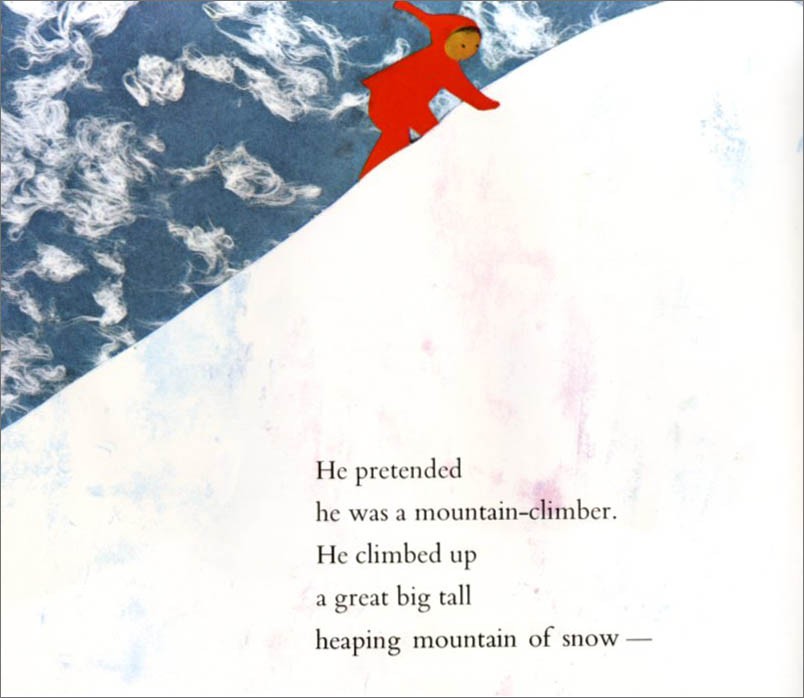
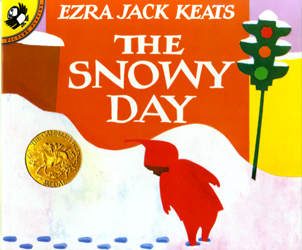
When Annis Duff asked Keats to write and illustrate his first solo book, he turned to a subject matter dear to him: the children who were playing on the streets of Brooklyn where he lived. In the “all white world of children’s books” their faces were not being reflected at all. Keats had saved a photograph of a black boy in his studio for years and used that picture as the model for Peter in The Snowy Day. A young boy, Peter dons a red snowsuit and explores his neighborhood during a magical snowfall. He makes snow angels, tracks his feet in the snow, and slides down a mountain of snow.
To illustrate the book, Keats used collage, because of the freedom it provided. He located a piece of Belgian canvas that he turned into bed linen, and to produce the image of a wall, he spattered India ink with a toothbrush. The artwork’s simplicity invites readers to enter into each picture with their own imagination. Many children have interpreted the white space below Peter’s sleeping face when he goes to bed as the snowball Peter created that day.
After the book won the Caldecott Medal in 1963, it was purchased for library collections throughout the country, and for a period of years The Snowy Day was often the only book to show the face of a person of color in many public and school libraries. Hence it had a profound influence on thousands of children who for the first time could see themselves in a book. National Book Award Winner Sherman Alexie in Everything I Need to Know I Learned from a Children’s Book talked about encountering this book in the library on his Spokane Indian Reservation: “I vividly remember the first day I pulled that book off the shelf. It was the first time I looked at a book and saw a brown, black, beige character—a character who resembled me physically and spiritually, in all his gorgeous loneliness and splendid isolation.”
By creating a successful book with a Black protagonist, Ezra Jack Keats encouraged others to publish multicultural books. Both he and the brave Newbery-Caldecott committee of 1963 changed the contents of children’s books forever.
Here’s a page from The Snowy Day: