Daily children’s book recommendations and events from Anita Silvey.
Discover the stories behind the children’s book classics . . .
The new books on their way to becoming classics . . .
And events from the world of children’s books—and the world at large.
Find a Book!
Search the archives for recommendations by age group, book type, subject, date, and more.

A Wrinkle in Time
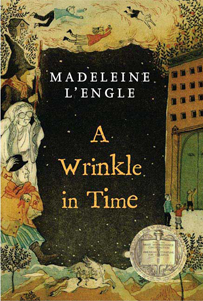
On March 12, 1963, the New York Times wrote “A housewife and an artist today won the nation’s top awards for the most distinguished children’s book published in 1962.” This statement doesn’t even hint at the truth—that the most courageous committee in the history of the Newbery and Caldecott Awards had just announced its results. In the 1960s a single committee chose both prestigious awards.
The housewife of the headlines, Madeleine L’Engle, married to television actor Hugh Franklin, had won the award for a book rejected by 26–40 publishers, the number changing depending on who was telling the story. She had, in fact, abandoned the idea of ever getting this saga, which had occurred to her while she was traveling across the Painted Desert, into print. Many claim credit for finally putting the manuscript into the hands of John Farrar—but there is no question that he and editor Hal Vursell decided to take a chance on a book that had no precedent. Part fantasy and part science fiction, A Wrinkle in Time features a girl as the protagonist in an era when science fiction clearly belonged to male heroes. Traveling through time and space Meg Murray and her precocious little brother Charles Wallace—along with Mrs. Whatsit, Mrs. Who, and Mrs. Which—are trying to save their father from a giant pulsing brain, the embodiment of evil.
Reviewers seemed a bit skeptical about this unusual story. However, Ruth Hill Viguers, the editor of The Horn Book Magazine wrote that although the book “will no doubt have many critics, I found it fascinating….It makes unusual demands on the imagination and consequently gives great rewards.” A book with a very small first printing, probably 1,500 copies, A Wrinkle in Time did not get placed in the hands of many children until it won the Newbery Award.
Along with Alice of Alice in Wonderland, Jo March of Little Women, and Anne of Anne of Green Gables, Meg has taken her place as one of the most loved and remembered female characters created in children’s books. Madeleine L’Engle put a good deal of herself into Meg, “Of course I’m Meg,” she once admitted. Her husband thought his wife understood Meg quite well but noted that Madeleine had “never explored outer space”—although he wouldn’t put it past her. Now after several decades, the book still draws young readers in and keeps them awake at night to finish the story.
In 1963 the Newbery-Caldecott committee definitely picked an unusual and challenging novel, a story that would both stand the test of time and become one of our greatest classics. On March 15, we will talk about the Caldecott-winning “artist” mentioned in that New York Times notice.
Here’s a passage from A Wrinkle in Time:
“Hi,” he said cheerfully. “I’ve been waiting for you.”
From under the table where he was lying at Charles Wallace’s feet, hoping for a crumb or two, Fortinbras raised his slender dark head in greeting to Meg and his tail thumped against the floor. Fortinbras had arrived on their doorstep, a half-grown puppy, scrawny and abandoned, one winter night. He was, Meg’s father had decided, part Llewellyn setter and part greyhound, and he had a slender, dark beauty that was all his own.
“Why didn’t you come up to the attic?” Meg asked her brother, speaking as though he were at least her own age. “I’ve been scared stiff.”
“Too windy up in that attic of yours,” the little boy said. “I knew you’d be down. I put some milk on the stove for you. It ought to be hot by now.”
How did Charles Wallace always know about her? How could he always tell? He never knew – or seemed to care – what Dennys or Sandy were thinking. It was his mother’s mind, and Meg’s, that he probed with a frightening accuracy.
Other books for this day
Also recommended:
- Wrinkle in Time Quintet (next volume A Wind in the Door) by Madeleine L’Engle
Additional Information
A few other events for
- Happy birthday Arlene Alda (Did You Say Pears?), Daniel Cohen (Real Ghosts), Naomi Shihab Nye (19 Varieties of Gazelle: Poems of the Middle East), Carl Hiaasen (Hoot), and Diane Gonzales Bertrand (The Party for Papá Luis).
- It’s the birth date of Virginia Hamilton (1936–2002), M. C. Higgins, the Great.
- In 1894 Coca-Cola is sold in bottles for the first time in Vicksburg, Mississippi. Read My Vicksburg by Ann Rinaldi, and The Drummer Boy of Vicksburg by G. Clifton Wisler.
- Moscow becomes new capital of Russia in 1918. Prior to that St. Petersburg was the capital city for 215 years. Read Eloise in Moscow by Kay Thompson, illustrated by Hilary Knight, and Max Moves to Moscow by Winifred Riser.
- Happy birthday to the Girl Scouts, first named Girl Guides in 1912. Read Daisy and the Girl Scouts: The Story of Juliette Gordon Low by Fern Brown, illustrated by Marie DeJohn.