
Daily children’s book recommendations and events from Anita Silvey.
Discover the stories behind the children’s book classics . . .
The new books on their way to becoming classics . . .
And events from the world of children’s books—and the world at large.

Find a Book!
Search the archives for recommendations by age group, book type, subject, date, and more.


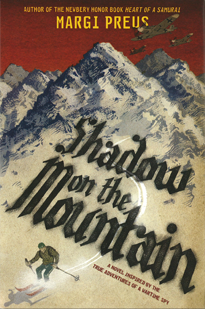
September has been designed Read a New Book Month. Certainly those headed back to school, whether teachers or students, will probably encounter some new titles in the next few weeks. I’d like to highlight a book just published in 2012: Shadow on the Mountain by Margi Preus.
Margi Preus has published two stellar books in the last couple of years, Heart of a Samurai and CelebriTrees: Historic and Famous Trees of the World. What distinguishes Preus, outside of her ability to tell a great story, is her inclination to pick original subjects for her books. She does not give us titles that a hundred other authors have already created. And, once again, in Shadow on the Mountain she brings to her readers a story untold in children’s books.
Inspired by the true adventures of a wartime spy, Shadow on the Mountain is set in the snowy terrain of Norway during World War II. The Nazis have invaded, and although the locals don’t have the troops to remove the invaders, they have citizens willing to risk their lives to foil the Nazi plan for Norway. Set in Lillehammer during 1940–1945, the book is filled with small examples of courage—wearing red hats, children staging walkouts, teachers refusing to comply with Nazi directions. But the main character of the book, fourteen-year-old Espen, becomes swept up in more dangerous activities. At first he serves as a carrier of messages and newspapers on his bicycle. Ultimately he infiltrates the Nazi headquarters and must flee on skies to Sweden to avoid torture and execution.
Shadow on the Mountain works brilliantly for children because of the action. Espen and his soccer team friends fight with the Nazi sympathizers. They bicycle and ski all over the country on missions. Espen’s final trek to Sweden has readers on the edge of their seats. There are lots of near escapes and terrifying moments. Shadow on a Mountain has a fascinating historical setting, but it is worth reading for the adventure and survival alone.
At the end of the book the author has provided information on Erling Storrusten and his wife, Aase-Berit, who served as models for two of the characters, a timeline, resources, and even information on codes and invisible ink. The book makes a natural pairing with Lois Lowry’s beloved Number the Stars. Both show how the smallest of political actions, even by children, can make an enormous difference in the life of a country.
Here’s a passage from Shadow on the Mountain:
Against the blue-black mountains, Espen’s bicycle was just a tiny moving speck. Far below the road, the river pulsed and rushed, swollen with rain and snowmelt. The sun had long ago slipped away, leaving just a thin fringe of light glimmering along the ragged edge of the western mountains. The dangerous time of day, his grandmother would have said, the time of day the trolls come out.
Head down, straining forward over the handlebars, Espen felt his heart pump in rhythm with his legs. The muscles in his arms and legs burned. His heart beat furiously, and, ridiculously, his stomach was growling. He was always hungry. How could he be hungry now?
Other books for this day
Also recommended:
- Number the Stars by Lois Lowry
Additional Information
A few other events for
- Happy Birthday Babette Cole (Dr. Dog, Princess Smartypants).
- It’s the birthdate of Robert M. McClung (1916-2006), author of Lost Wild America: The Story of Our Extinct and Vanishing Wildlife and The True Adventures of Grizzly Adams.
- Also born on this day was Marie Laveau (1801-1881), a famous New Orleans voodoo queen. Read Voodoo Queen: The Spirited Lives of Marie Laveau by Martha Ward.
- It’s Sewing Machine Day! On this day in 1846 Elias Howe patented the sewing machine. Read Queen of Inventions: How The Sewing Machine Changed The World by Laurie Carlson.