Daily children’s book recommendations and events from Anita Silvey.
Discover the stories behind the children’s book classics . . .
The new books on their way to becoming classics . . .
And events from the world of children’s books—and the world at large.
Find a Book!
Search the archives for recommendations by age group, book type, subject, date, and more.
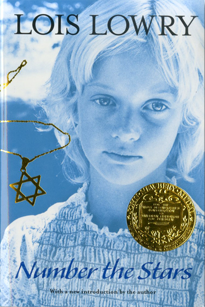
Seventy-six years ago on July 30, 1935, the modern paperback revolution began when Sir Allen Lane published the first Penguin paperback. I have always been grateful that he was knighted for this achievement—and that in the United States, beginning in the sixties, paperback books for children became a staple of publishing lists. Although I love hardcover books, I must admit that today’s paperbacks often look just as nice as the original—and, of course, they allow many more children to have access to these books. This is true of the book of the day, Lois Lowry’s Number the Stars, just released in a new, striking paperback.
In 1989 Lois Lowry, who has distinguished herself by the range and quality of her writing for children, tackled the subject of the Holocaust in a book for fourth through seventh graders. One of the hallmarks of the Lowry cannon rests in her ability to bring any subject, no matter how complex, into the emotional and intellectual range of children. For years Lois had listened to the stories of her friend Annelise Platt, who experienced World War II as a youngster in Denmark. By creating a very engaging and sympathetic Danish child, Annemarie, Lowry found a way to talk about the events of World War II in Demark as a child would experience them.
Ten-year-old Annemarie Johansen and her Jewish friend Ellen are inseparable, and their mothers are also best friends. When Nazi soldiers begin the roundup of the Jews, Annemarie’s family hides Ellen and gets the girl and her parents to their uncle, who runs a fishing operation near Sweden. Then one night, when the coffin for “Great-aunt Birte” is brought to Uncle Henrik’s house, several Jewish refugees receive clothing and provisions and prepare for a boat ride to freedom. Because part of the plan goes awry, Annemarie must travel, in the dark of night, with a basket for her uncle—one that contains a handkerchief that will confuse the Nazi dogs’ sense of smell.
Each chapter has been beautifully crafted; each moves the story along. From the first moments when Annemarie encounters Nazi soldiers to the final page when Denmark has been freed, readers stay with her, cheer her on, and hope that she makes the right choices. The life of her best friend rests on the thin shoulders of this child. Ultimately, Number the Stars explores the issue of taking political action, even if to do so might mean death. The book also shows Denmark at one of its finest hours in history—a time when the citizens banded together, forgetting religious differences.
In the new paperback edition, Lowry provides an introduction to her classic. She says that ten “is an age when young people are beginning to develop a strong set of personal ethics. They want to be honorable people. They want to do the right thing.” Used in many schools, read independently, or shared in families, Number the Stars shows young readers a protagonist who achieves that goal. It takes one of the darkest periods of world history and brings light and beauty into the landscape.
Here’s a passage from Number the Stars:
“
Halte!” the soldier ordered in a stern voice.The German word was as familiar as it was frightening. Annemarie had heard it often enough before, but it had never been directed at her until now.
Behind her, Ellen also slowed and stopped. Far back, little Kirsti was plodding along, her face in a pout because the girls hadn’t waited for her.
Annemarie stared up. There were two of them. That meant two helmets, two sets of cold eyes glaring at her, and four tall shiny boots planted firmly on the sidewalk, blocking her path to home.
And it meant two rifles, gripped in the hands of the soldiers. She stared at the rifles first. Then, finally, she looked into the face of the soldier who had ordered her to halt.
Other books for this day
Also recommended:
- Darkness Over Denmark by Ellen Levine
Additional Information
A few other events for
- Happy birthday Marcus Pfister (The Rainbow Fish).
- It’s the birth date of Henry Ford (1863-1947). Read Driven: A Photobiography of Henry Ford by Don Mitchell.
- Happy birthday to Baltimore, Maryland, founded in 1729. Read Goliath: Hero of the Great Baltimore Fire by Claudia Friddell, illustrated by Troy Howell, and Anna All Year Round by Mary Downing Hahn, illustrated by Diane de Groat.
- In 1942, WAVES (Woman Appointed for Volunteer Emergency Services), the women’s section of the U.S. Navy was established. Read Women Heroes of World War II by Kathryn J. Atwood.
- It’s National Cheesecake Day. Read The Cheese by Margie Palatini, illustrated by Steve Johnson and Lou Fancher, and Who Made This Cake? by Chihiro Nakagawa, illustrated by Junji Koyose.