
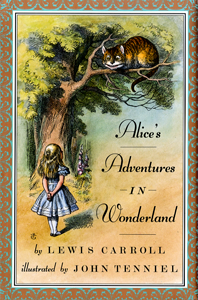
On November 26, 1865, a children’s book was published by Macmillan in England that has remained in print ever since: the longest standing and best-known of our classics, Lewis Carroll’s quirky and unforgettable Alice in Wonderland. Although it was clearly written and intended for children, its richness and complexity also make it appealing to adults. It has been embraced by rock groups like Jefferson Airplane, movie moguls likeTim Burton, royalty like Queen Victoria of England, and millions of college students and writers.
The book began while Oxford don and mathematician Charles Dodgson took the three Liddell daughters out on a boat trip down the River Thames and entertained them with a story. After Alice begged to have it written down, Dodson embellished his tale, publishing it under his nom de plume Lewis Carroll. Even with its modest first printing of two thousand copies, the book quickly took hold of readers and became the darling of parents and children alike.
In Alice in Wonderland Alice falls down a rabbit hole into a bizarre world where all logic seems reversed. In 1871 Carroll continued Alice’s story in Through the Looking Glass, and What Alice Found There. In this sequel, Alice discovers she is a pawn in a chess game dominated by the Red Queen. Today it is impossible to imagine either story without the artwork of Sir John Tenniel. But author and illustrator squabbled incessantly while the books were created, and Carroll considered Tenniel less than ideal for the project.
Translated into more than 125 languages, the two books brought to life an incredible cast of characters who have become part of popular culture—the March Hare, Cheshire Cat, White Rabbit, Tweedledee, Tweedledum, and the Jaberwock—to name only a few. And, of course, Alice herself has inspired legions. As Professor Alice Gopnik, of the University of California at Berkeley, wrote in Everything I Need to Know I Learned from a Children’s Book: “I think every scientist and every child is the grave, wide-eyed little girl who fearlessly follows evidence and logic wherever it leads—even through the looking glass and down the rabbit hole.”
Happy birthday, Alice in Wonderland. Thank you for showing us that the very best books for children just get better over time and that they can entertain and sustain us throughout all the stages of our life.
Here’s a page from Alice in Wonderland:
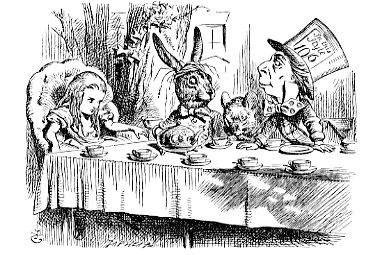
Alice had been looking over his shoulder with some curiosity. “What a funny watch!” she remarked. “It tells the day of the month, and doesn’t tell what o’clock it is!”
“Why should it?” muttered the Hatter. “Does your watch tell you what year it is?”
“Of course not,” Alice replied very readily: “but that’s because it stays the same year for such a long time together.”
“Which is just the case with mine,” said the Hatter.
Alice felt dreadfully puzzled. The Hatter’s remark seemed to her to have no sort of meaning in it, and yet it was certainly English.