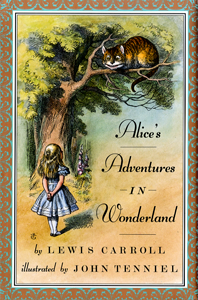

Often, with classic children’s books, we remember both the writer and the illustrator. So Lewis Carroll brings to mind the illustrations of Sir John Tenniel. Contemporary readers appreciate Tenniel more than Lewis Carroll ever did—he was basically disappointed with the art for Alice in Wonderland.
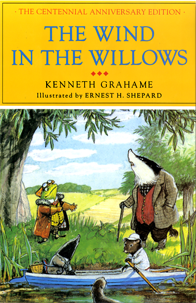
Fortunately, our birthday celebrant, Ernest H. Shepard, born 132 years ago, found more appreciative writers when he matched their texts with his drawings. Both A. A. Milne and Kenneth Grahame thought him amazingly sensitive to their work. Milne recommended our birthday boy to Grahame, who had long wanted an illustrated edition of The Wind in the Willows. “I love these little people, be kind to them,” Grahame implored E. H. Shepard when he handed over the text for what became the 1931 edition of the book.
P. L. Travers was so enthralled with Shepard’s work and his mastery of humorous illustrations that she longed to have him create art for Mary Poppins. Although he declined, his daughter Mary took over the project.
With a grandfather well known for his watercolors and a father who was an architect, Shepard received early encouragement for his artistic career. At eighteen, he entered the Royal Academy Schools where he met his wife, Florence. Creating artwork for the British humor magazine Punch, he became adept at showing human expression with the subtlest use of line. Later, of course, he would be known for his ability to bring characters and their personalities to life.
One Saturday morning, without an appointment, Ernest Shepard brought a portfolio of sketches to the home of poet and playwright A. A. Milne. Surprised by his uninvited guest, Milne still looked at the drawings and liked what he saw. So Shepard was invited to illustrate Milne’s book of poems, When We Were Very Young (1924), and later he provided the perfect blend of whimsy and naïveté for Winnie-the-Pooh (1926). In the tried and true method of illustrators, Shepard modeled Pooh on a bear owned by his own son, named “Growler.” Even though it often annoys writers, artists get to use their family and friends as models.
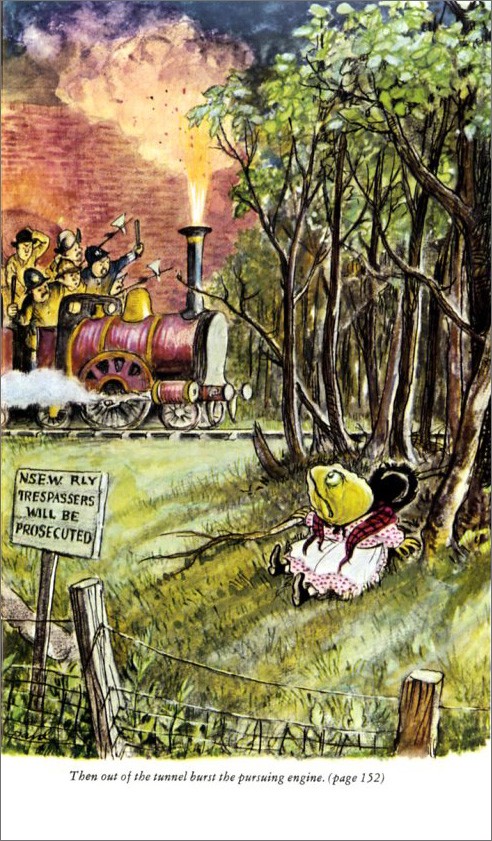
When he worked with Grahame on The Wind in the Willows, the author showed Shepherd the nearby river that had inspired the book; Shepard spent time there with his sketchbooks, searching for details like Rat’s boathouse or holes in the ground where Mole might live. Although Grahame did not live to see the book finished, he approved the drafts that Shepard provided and knew before he died that his characters were being given the care and attention they needed. In 1959 Shepard created full page color illustrations for Graham’s classic (see below).
In 1972, a few years before his death, Shepard received the Order of the British Empire. An even more important honor is that every day young readers pick up the books for which he became famous. Happy birthday and thank you, Ernest H. Shepard; for generations of readers you have brought Christopher Robin, Pooh, Mole, Rat, and Badger to life in your drawings.
Here’s a page from The Wind in the Willows: