Daily children’s book recommendations and events from Anita Silvey.
Discover the stories behind the children’s book classics . . .
The new books on their way to becoming classics . . .
And events from the world of children’s books—and the world at large.

Find a Book!
Search the archives for recommendations by age group, book type, subject, date, and more.

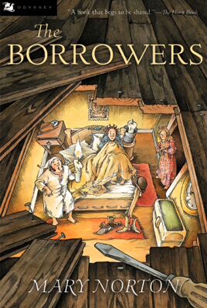
On January 4, 1838, Charles Sherwood Stratton, the most famous small person in history, was born in Bridgeport, Connecticut. After being discovered by another resident of the city, P. T. Barnum, Stratton received a new name, General Tom Thumb. Our book of the day, Mary Norton’s The Borrowers, celebrates General Tom Thumb—and little people in general.
The protagonists of this story, Arrietty Clock and her parents, Pod and Homily, are far smaller than General Tom Thumb. Essentially tiny people who live under the kitchen floorboards of an underpopulated mansion, they “borrow,” or take, all of their food and supplies from the home. They have wallpaper made from writing paper and a ceiling constructed from an old cigar box. Once the community of Borrowers had been rich and diverse, and Homily knows the genealogy of all members of the clan. But now the family lives in isolation, with only memories of those who had been in their lives.
Which is why Arrietty longs for companionship. One day, on a journey with her father to fetch things for their home, she is observed by a human boy. Arrietty begins a clandestine relationship her mother would not approve of —Homily believes “human beans” should be avoided at all cost. This theme, of course, is one of the oldest in literature and works well in The Borrowers, just as it did in Shakespeare’s Romeo and Juliet. Attempting to help the family acquire nice furniture (from a dollhouse), the boy inadvertently causes the family to be discovered and almost destroyed.
An actress and once a member of London’s Old Vic Theatre Company, Mary Norton began writing children’s novels in the forties and started crafting the five-volume Borrowers series in the fifties. In it she set out to explain what happens to all those small household objects, like safety pins, that always seem to disappear. Part of the appeal of the story lies in the miniature world created by the Clock family, but Norton brings in lots of adventure and action as they attempt to survive without being seen by people.
Because of Mary Norton, I have spent a lifetime believing in Borrowers. Just the other day, when I could not find any needles, I suspected once again that I might have a colony of Borrowers in my home. In February the Japanese film, The Secret World of Arrietty, will give everyone a chance to see Borrowers on the silver screen. But maybe my dogs will find some before then!
Here’s a section from The Borrowers:
Beside the fire, in a tilted wooden bookcase, stood Arrietty’s library. This was a set of those miniature volumes which Victorians loved to print, but which to Arrietty seemed the size of very large church Bibles. There was Bryce’s Tom Thumb Gazetteer of the World, including the last census; Bryce’s Tom Thumb Dictionary, which short explanations of scientific, philosophical, literary, and technical terms; Bryce’s Tom Thumb Edition of the Comedies of William Shakespeare, including a foreword on the author; another book, whose pages were all blank, called Memoranda; and last but not least, Arrietty’s favorite Bryce’s Tom Thumb Diary and Proverb Book, with a saying for each day of the year and, as a preface, the life story of a little man called General Tom Thumb, who married a girl called Mercy Lavinia Bump. There was an engraving of their carriage and pair, with little horses the size of mice. Arrietty was not a stupid girl. She knew that horses could not be as small as mice, but she did not realize that Tom Thumb, nearly two feet high, would seem a giant to a Borrower.
Other books for this day
Also recommended:
- The Borrowers Afield and the rest of the series by Mary Norton
Additional Information
A few other events for
- Happy birthday Phyllis Reynolds Naylor (Shiloh trilogy, Alice series) and Robert Burleigh (Hoops, One Giant Leap).
- It’s the birth date of Jakob Grimm (1785–1863), Grimm’s Fairy Tales.
- It’s World Braille Day. Louis Braille (1809–1852), the creator of braille, a system enabling blind and visually impaired people to write and read, was born on this day. Read Louis Braille: A Touch of Genius by C. Michael Mellor, A Picture Book of Louis Braille by David A. Adler, illustrated by John and Alexandra Wallner, and Out of the Darkness by Russell Freedman, Illustrated by Kate Kiesler.