

On July 1, 1874, the first zoo in the United States opened its doors to visitors in Philadelphia. A quarter for adults and a dime for children allowed visitors to view 813 animals housed there. Three thousand people traveled by foot, horse and buggy, or steamboat to look at the wonders.
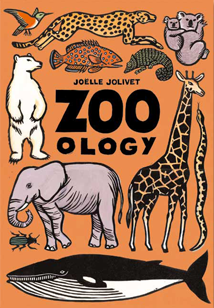
Thousands of books about zoos or zoo animals have been published for children since 1874, but if I had only one of them to pack in a trunk and take to an island, it would be an easy choice for me. Admittedly, I’d need a big trunk; the oversized volume stands almost a foot and a half tall. From the minute you spot its reddish-orange cover across the room, Zoo-ology begs to be opened. Joëlle Jolivet, a brilliant French illustrator, crafted the art. Emmanuelle Grundmann, Zoology Consultant of the French National Museum of Natural History, provides fabulous notes.
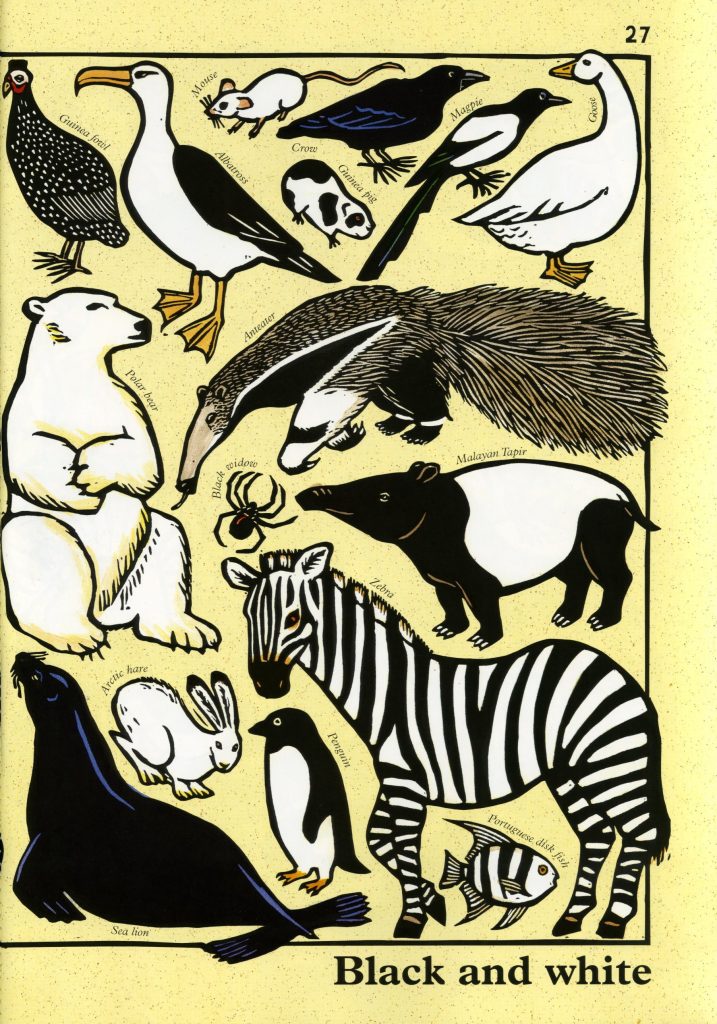
Every double spread features animals, insects, fish, or amphibians, grouped sometimes by climate (hot, cold), by form (feathered, horned), habitat (in the seas, in the trees, underground), or color (black and white, spots and stripes). All have their name close to their images, except for the chameleon that moves from page to page and changes color. Children love finding him in each double-page spread as he ambles through the book. Each page has been so imaginatively constructed that you can spend hours studying the creatures and testing your knowledge of zoology. After your eyes have feasted on the book, you can go to the endnotes. Here we learn that the beluga whale was once called the “canary of the sea” because of its song or that the civet’s liquid for marking its territory is used in making perfume. Each sentence contains a fascinating fact, conveyed in minimal words.
If I were decorating an elementary school classroom, I’d buy a few copies and use the spreads as posters. These images also serve as models of graphic design but also inspire students artistically. In short, whether at school or as a beloved treasure at home, this is a book that I wish every child in the United States, even preschoolers, could pick up. Not only does it make readers want to quickly head to a zoo, but it also encourages its viewers to research a creature that has caught his or her fancy.
So happy birthday, Philadelphia Zoo. I can’t get there today for a visit—but I will do the next best thing and pick up Zoo-ology one more time.
Here’s a page from Zoo-ology: