
The end of February can be brutal in New England. Certainly more than one inhabitant of the region has felt that powers of darkness have seized the barren land. And during the end of February 1692, the Reverend Samuel Parris and other ministers in Salem, Massachusetts, grilled two children, nine-year-old Betty Parris and her eleven-year-old cousin Abigail Williams, about the presence of truly malevolent spirits in the community. Consequently, on February 29, 1692, two Salem town magistrates filed an official complaint against three women accused of witchcraft and set in motion the infamous Salem Witchcraft Trials.
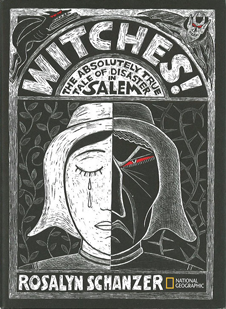
The claiming of innocent lives because of mass hysteria, the miscarriage of justice, and the fact that children and teenagers played key roles in the incident have all made the Salem Witchcraft Trials one of the most popular subjects in children’s books over the years. In Sibert Honor Award–winner Witches: The Absolutely True Tale of Disaster in Salem, author and illustrator Rosalyn Schanzer adds something new to the discussion.
The book opens with cameo portraits of those accused of witchcraft and the people responsible for persecuting them. She provides background for the story, showing how early New England settlers, the Puritans, believed in witches, witchcraft, and the devil. Then she plays out the events of the story—the accusations, the trials, the deaths of innocent people—in a dramatic way. While doing so, she gives background on the law and courts and the changing nature of allowable evidence under Massachusetts law.
One of the most poignant parts of the book actually comes at the end in sketches about what happened to people after the trial. In 1706, at the age of twenty-nine, Ann Putnam, one of the chief accusers, read the following statement: in her childhood she had been “an instrument for accusing severall persons of a grievous crime, whereby their lives were taken away. I now have good reason to believe they were innocent, and justly fear I have been instrumental with others, though unwittingly, to bring upon myself the guilt of innocent blood.” As Witches! so brilliantly shows, inappropriate actions in childhood can cast a long shadow over a life.
The book makes a perfect introduction to the Salem Witch Trials for third through fifth graders who know little or nothing about these events. Although the book focuses on history, it can be used to introduce topics of slander, name calling, and bullying—for such were the weapons of the children of Salem Village. In a small, compact book Schanzer creates an exciting narrative and explores some of the reasons why things spun out of control in Salem Village so many years ago.
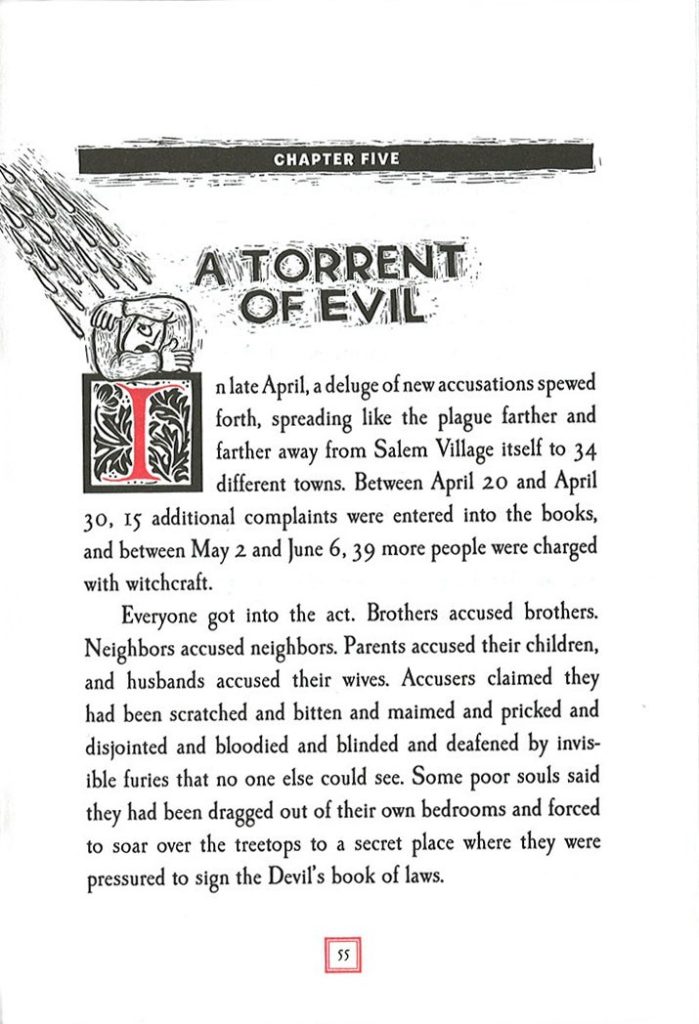
Here’s a page from Witches!: