

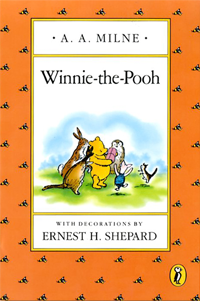
Today has been designated Winnie-the-Pooh Day. On October 14, 1926, a British playwright, who also liked to dabble in poetry and prose for children, published a book named after a stuffed toy bear: “Here is Edward Bear, coming downstairs now, bump, bump, bump on the back of his head, behind Christopher Robin.”
Milne’s son Christopher Robin had been, with the help of his mother, making up stories about his toys. Eventually Alan Milne joined in, writing an occasional poem and scene about Pooh and Christopher’s other toys—Piglet, Eeyore, Owl, Kanga and Roo, and Tigger, the tiger who liked to bounce. Milne spun these tales out, adding his own blend of whimsy and creative imagination to the material that Christopher had already provided. In the wonderful Hundred Acre Wood, these animals and Christopher Robin build a trap for a Heffalump, plan an “expotition” to the North Pole¸ and engage in a variety of exciting activities.
Then, one Saturday morning, the artist Ernest Shepard, who did not have an appointment, called on Milne at home to show a portfolio of his sketches. Milne loved these drawings, and consequently Shepard provided drawings for Milne’s poetry volume, When We Were Very Young, and also Winnie-the-Pooh. Milne then introduced Shepard to Kenneth Graham, who badly wanted an illustrated edition of The Wind in the Willows.
Today at New York Public Library’s Children’s Center at 42nd Street, the old and now battered toys of Christopher Robin Milne have found a permanent home. Preserved in cases for the delight of other children, they stand stiff and lifeless in place. Like all toys, they needed the care and imaginative power of their owner—and in this case, his father—to bring them to life.
I’m glad a Winnie-the-Pooh Day exists; the world is a better place because of this book. It has made children and families laugh, recite poetry, and even sing together for decades.
Here’s a passage from Winnie-the-Pooh: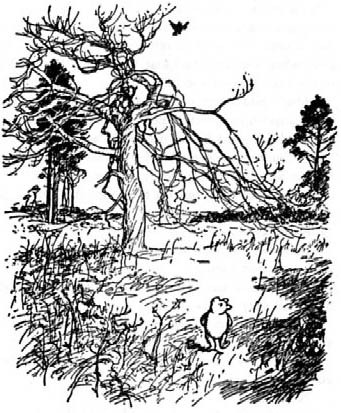
Edward Bear, known to his friends as Winnie-the-Pooh, or Pooh for short, was walking through the forest one day, humming proudly to himself. He had made up a little hum that very morning, as he was doing his Stoutness Exercises in front of the glass: Tra-la-la, tra-la-la, as he stretched up as high as he could go, and then Tra-la-la, tra-la–oh, help!–la, as he tried to reach his toes. After breakfast he had said it over and over to himself until he had learnt it off by heart, and now he was humming it right through, properly.