

Today marks National Polar Bear Day, to celebrate the world’s largest carnivore. Although we have honored a lot of penguins on this website (Mr. Popper’s Penguins and 365 Penguins), polar bears have received scant notice. So today I’d like to honor a polar bear—although he happens to be the best friend of a penguin. In fact, he’s called only “Polar Bear” in the text; the penguin gets a name, Whiteblack. Possibly penguins are the publicity hounds of the children’s book world—they get all the media attention.
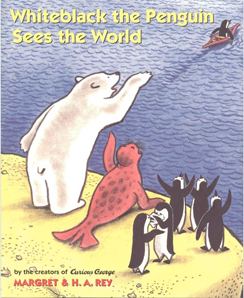
Whiteblack the Penguin Sees the World by Margret and H. A. Rey, better known for their Curious George books, was created in Paris around 1937. The two Germans citizens had met in an advertising agency in Rio de Janeiro, gotten married, and headed for a two-week honeymoon to Paris. They stayed for more than two years and would have stayed longer had the Nazis not interrupted their idyll. Margret, who always knew how to tell a good story, maintained that Hans had been selling bathtubs, up and down the Amazon River, before he met her. When I once asked her if this were really true, she rolled her eyes and said, “Ah, Anita, it was so long ago, and it is such a good story, why do you ask?”
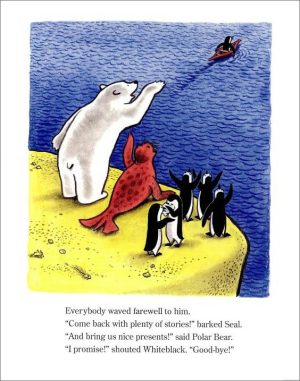
In 1937 Hans worked in the Brazilian Pavilion at the World’s Fair, across from the penguin exhibit. He loved drawing these animals and began work on a story that would feature them—and friends Polar Bear and Seal. In his diaries, he noted that he alternated between working on Whiteblack one day, and then switching to the other book he was developing, Curious George, the next. Eventually, the saga of Whiteblack emerged. A radio announcer, Whiteblack has run out of stories—so he decides to go around the world because travelers have good stories to tell. His friend Polar Bear waves good-bye, and Whiteblack hijacks passage on a naval cruiser, rides a camel, races on a skateboard through the desert, sails on a boat, and eventually brings presents and stories back to his friends.
When the Reys fled Paris in 1940, they brought Whiteblack with them. After they arrived in the United States, they showed it to Grace Hogarth, their editor at Houghton, and Ursula Nordstrom, their editor at Harper. Hans worked on some changes that Nordstrom suggested. Then they abandoned this book for other projects—and Whiteblack, now a fully finished book, sat unpublished. After their deaths, the Reys’ diaries, letters, and manuscripts were donated to the de Grummond Children’s Literature Collection of the University of Southern Mississippi at Hattiesburg. In 1999, while I was looking through an exhibit at the university, I saw the jacket of Whiteblack the Penguin in a case. “I don’t know this one,” I said to curator Dee Jones. “Oh,” she replied, “would you like to see the whole book?” As I opened the jacket, on the inside of the front page, “Propriete de l’auteur H. A. Rey, Paris” sent a chill down my spine. I knew I was looking at a manuscript created by Hans in Paris.
Published for the first time in 2000, Whiteblack the Penguin Sees the World still gives me a chill—a perfectly formed book that spent decades unnoticed, tucked away in other papers. In many ways, the book stands as the autobiography of Hans and Margret—they traveled the world and then had stories to tell. Fortunately, like Whiteblack, they had friends—Grace Hogarth and Ursula Nordstrom and millions of readers—who welcomed them home and delighted in the presents they brought with them.
Here’s a page from Whiteblack the Penguin Sees the World: