Daily children’s book recommendations and events from Anita Silvey.
Discover the stories behind the children’s book classics . . .
The new books on their way to becoming classics . . .
And events from the world of children’s books—and the world at large.
Find a Book!
Search the archives for recommendations by age group, book type, subject, date, and more.
When My Name Was Keoko
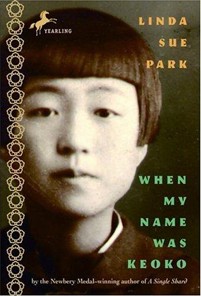
Today Koreans celebrate Memorial Day — to pay tribute to those who died in war. Although very few books for children are set in Korea, Linda Sue Park’s extraordinary novel When My Name Was Keoko, published in 2002, explores World War II as seen by Korean citizens.
For this powerful novel, Linda Sue Park, winner of the Newbery medal for A Single Shard, interviewed members of her Korean family for details about their experience during World War II. Set in Korea right before the Japanese attack on Pearl Harbor, the novel is narrated by two engaging protagonists, Sun-hee, age ten, and her older brother Tae-yul, thirteen. Forced to give up their Korean names and abandon the Korean language, the two struggle to deal with the Japanese occupation of their home. Sun-hee studies hard, hoping to become a scholar like her father. Tae-yul rebels, hating the Japanese history lessons forced down his throat.
Their uncle, who becomes a member of the Korean resistance, must leave home to escape capture. Their father tries to survive passively. Toward the end of the war, Tae-yul signs up for the Japanese army and receives training to become a Kamikaze pilot. In one of the most chilling chapters in children’s fiction, he and other young men prepare for their final suicidal flight.
Park weaves history and culture, family and friendship, deprivation and life’s joys together seamlessly in this novel. Although she does not avoid the horrors of the situation, she brings the events to a hopeful and happy conclusion—a free Korea where the young people can have their own names and customs. When My Name Was Keoko, in fact, ends with two young people practicing their once-forbidden Korean language.
When My Name Was Keoko explores the tremendous upheaval of war, the fate of minority people in times of crisis, and the power of language to shape identity. For any adult or child ages ten through fourteen seeking information about the significance of Korean Memorial Day, When My Name Was Keoko brings these historic events alive and makes readers understand why this day in history needs to be celebrated. Once readers encounter it, they will never look the same way on the war in the Pacific during World War II.
Here’s a passage from When My Name Was Keoko:
It wasn’t fair. Why couldn’t girls ride bicycles? It wasn’t like the old days when girls had to wear long skirts. Omoni still wore long skirts, and so did a lot of older women. But young women and girls like me wore trousers. Omoni had told me it was the Japanese who had brought in this style. A lot of people hadn’t liked it, but I couldn’t understand why. Trousers were much easier to wear, and better for playing in.
Also recommended:
- The Kite Fighters by Linda Sue Park
- The Single Shard by Linda Sue Park
Additional Information
A few other events for
- Happy birthday Maxine Kumin (What Color is Ceasar?, The Microscope), Peter Spier (People, The Fox Went out on a Chilly Night), Cynthia Rylant (The Relatives Came, When I Was Young in the Mountains), Geraldine McCaughrean (The White Darkness, Peter Pan in Scarlet).
- It’s the birth date of Will James (1892-1942), Smoky, The Cowhorse, Verna Aardema (1911-2000), Why Mosquitoes Buzz in People’s Ears, and Miriam Schlein (1926-2004), Year of the Panda.
- It’s National Yo-Yo Day. Read Knots in My Yo-yo String by Jerry Spinelli; Yo-Yo Man by Daniel Pinkwater, illustrated by Jack Davis; and Yo? Yes! By Chris Raschka.