
On January 9, 1886, Walter R. Brooks was born in Rome, New York. Orphaned at an early age, he was sent to a military academy and then attended the University of Rochester. An interest in homeopathic medicine brought him to New York City, where he worked for the Red Cross. He then turned his hand to writing, at first stories for The New Yorker and Scribners.
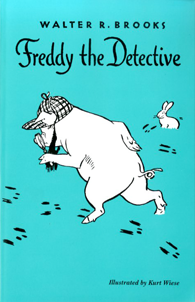
Many of his short stories for adults, which appeared in Saturday Review and Esquire, featured Ed the Talking Horse—the inspiration for a 1960s television series. But Brooks’s novels for young people centered on a very unlikely protagonist—who overeats, sleeps too much, daydreams, and is very lazy. Not the usual characteristics of a heroic figure. But Freddy is a pig, and he starred in twenty-six books that began in 1927 with Freddy Goes to Florida. Freddy, however, does possess virtues; he is even something of a Renaissance pig. He writes poetry, paints, edits the Bean Home News, and most important, runs a successful detective agency that has been based on the solid principles established by Sherlock Holmes. Freddy is also a balloonist, a magician, a campaign manager, and a pilot. He and the other barnyard characters—Mrs. Wiggins the cow, Jinx the cat, Hank the horse, and Charles the bragging rooster—have a lot of interesting adventures together. All of these books prove that animal fantasy, with just the right amount of humor, can entertain adults and children in equal measure.
Brooks brought American homespun humor and a profound understanding of children to his books. As he said, “Children are people; they are just smaller and less experienced [than adults]. They are not taken in by the smug playfulness of those who write or talk down to them as if they were dull-witted and slightly deaf.”
Extremely popular for years, the Freddy books began to go out of print in the 1980s, although they were never out of favor with an avid “Friends of Freddy” fan club. In the 1990s, Overlook Press began reprinting these funny, gentle stories again, bringing them to a new generation of readers. In Everything I Need to Know I Learned from a Children’s Book, writer Adam Hochschild wrote about his fascination with Freddy and the entire series of books: “the moral center of my childhood universe, the place where good and evil, friendship and treachery, honesty and humbug were defined most clearly, was not church, not school, and not the Boy Scouts. It was the Bean Farm…. Essentially, [the books] evoke the most subversive politics of all: a child’s instinctive desire for fair play.”
Happy 115th birthday Walter R. Brooks; over the years, you have made it possible for so many families to enjoy your gentle, but funny, universe.
Here’s a passage from Freddy the Detective:
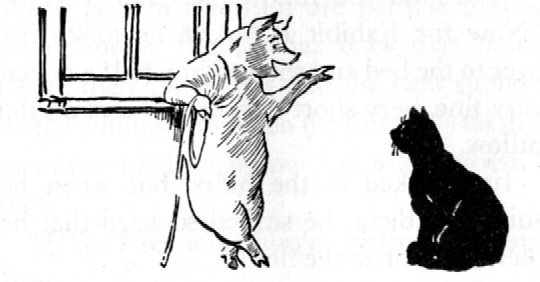
But Freddy did not answer. He was being a detective for all he was worth. He went very carefully over the floor, and then he examined the bed and the window-sill, and finally he got a tape measure out of Ella’s little sewing-basket and measured the height of the sill and the distance from the bed to the window and several other things. Jinx sat down by the door and watched, trying hard to look superior and sarcastic. But it’s hard to look superior and sarcastic all by yourself when nobody’s paying any attention to you, so after a while he give it up and went to sleep.