





On March 3, 1983, one of Belgium’s most famous citizens, Hergé, died at the age of seventy five. Over the years his adventure stories have been translated into more than thirty languages and have made the brave and resourceful snub-nosed reporter Tintin and his fox terrier Snowy popular with both adults and children around the world. In twenty-four books, told completely as comic strips, Tintin and Snowy travel to various exotic places, including America, where he takes on the Chicago mobster Al Capone.
Hergé, the pen name of Georges Remi, began creating material for the Catholic newspaper where he worked, Le Vingtième Siècle, and in 1929 Tintin and Snowy first appeared in their children’s supplement. They printed Tintin in the Land of the Soviets a year later. The character of Tintin was partly inspired by Georges’s brother Paul Remi, an officer in the Belgian army. After the Nazi occupation of Brussels, when the newspaper was shut down, Hergé produced a new Tintin strip in Le Soir. Because of paper shortages, Tintin was published daily in three or four frames. In this short format Hergé had to introduce more cliff hangers and faster action. That meant the comic strips, when issued as books, kept readers even more enthralled with chases, narrow scrapes, and page-turning stories.
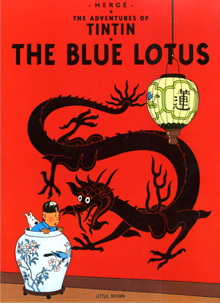
The Blue Lotus (1936) has always been considered the best of Hergé’s offerings. In an attempt to reproduce the Chinese culture with accuracy, he befriended a young Chinese student. In appreciation, Hergé included this young sculptor, Chang Chong-Chen, as a character in the adventure. The story had roots in current events and was a clear protest of Japanese expansion into China’s mainland. Tintin had many other notable adventures as well, including landing with Snowy on the moon in Explorers on the Moon, fifteen years before the actual moon landing of Apollo 11.
Although these books sold millions of copies worldwide, they did not find an American publisher until the 1970s. The comic book format was considered sub-standard literature in the United States at that time, not ideal for young readers. This perception, and probably some of the stereotypes in the books themselves, made children’s book editors wary. Poet Peter Davidson, then director of the Atlantic Monthly Press, loved the books and decided to take a chance on them. Melanie Kroupa oversaw their publication after she joined the staff as editor of children’s books in the 1980s. As she has written, “With exotic adventure and narrow escapes, bold graphic style, slapstick humor and wit, these books seem as appealing today as they did when the brilliant Hergé wrote and illustrated them. They’re classic and classy.”
Intelligent, kindhearted, and fearless, Tintin has beguiled young readers around the world. Even the charismatic French President Charles de Gaulle once remarked, “my only international rival is Tintin.”
Here’s a page from The Blue Lotus: