
For the upcoming Great Books Week, I want to look at the work of Paul Galdone. In his lifetime, Paul received very little critical praise for his books, although he did garner two Caldecott Honors for Eve Titus’s Anatole and Anatole and the Cat. Beginning in the fifties, he illustrated the work of others for many years, including Ellen MacGregor’s fabulous Miss Pickerell Goes to Mars. How I wish that gem were still in print!
But Paul would become loved for his renditions of classic nursery rhymes and fairy tales. At a time when such books formed the backbone of all publishing lists, Paul’s basic retellings of classic tales stood out as the most popular in a very crowded field. It is easy to forget today that in the eighties the children’s literature market was full of retold fairy tales. I was editor of the Horn Book during this time, and Walter Lorraine at Houghton once wrote to me suggesting that I run an article “Fairy Tales: Who Needs ’Em.” Certainly by the mid-nineties publishers had decided that they didn’t. Only in the past few years have we seen an increase in fairy-tale retellings—although, admittedly, many of our offerings for children today can best be described as fractured fairy tales.
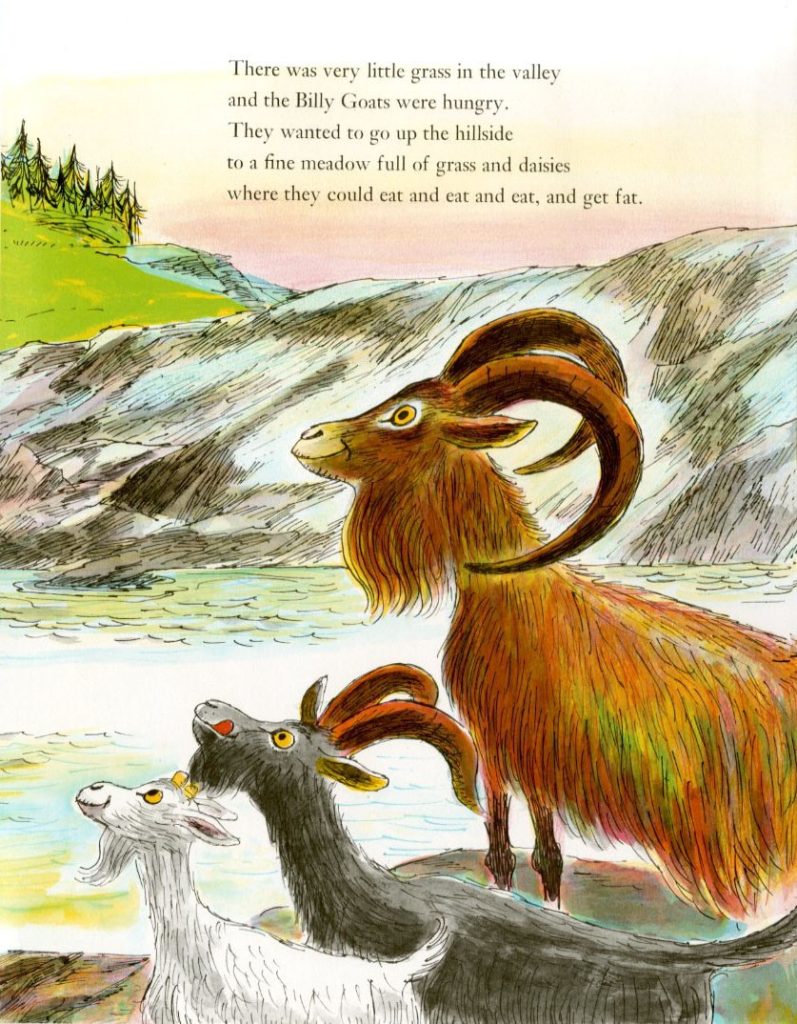
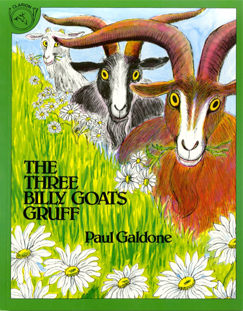
But not Paul Galdone’s. He retold his work in a straightforward manner, going for the essence of the stories. Hence when Children’s Books and Their Creators appeared in 1995, the essay on Galdone talked about how his books have “aged well and remain the old reliables of folk literature.” Sixteen years later they are still the old reliables. If you are hunting for a version of a folktale as you remember it, you can do no better than pick up a Galdone retelling. I have always thought that The Three Billy Goats Gruff is a great place to begin when looking at the Galdone canon.
“Once upon a time there were three Billy Goats. They lived in a valley and the names of all three Billy Goats was ‘Gruff.’” On a double-page spread, readers are greeted with three winsome goats, each with distinct personalities, coats, markings, and horns. All look directly at the viewer. Then the three goats try to get to the meadow across a bridge, guarded by a very ugly troll. The text is spare; action occurs on every page; the language is repetitive; and the essence of the story is captured. This Galdone rendition relies on sound storytelling principles. You can read the text a hundred times if necessary—and if the children in your life have anything to say about it, you might have to.
Paul Galdone created books at a time when “high art” picture books received all the accolades. But his enduring legacy, in books like The Three Billy Goat Gruff, is to remind us that children always love a good story, well told, that cuts to the heart of the matter.
Here’s a page from The Three Billy Goats Gruff: