


On January 6, or close to it, in 1412, a peasant girl destined to become a saint was born in Domrémy-la-Pucelle, France. As a teenager, Joan of Arc experienced visions, heard voices, and set out to save the King of France. She delivered Orleans from a siege during the Hundred Years War and paved the way for Charles VII to be crowned. Burned at the stake by the English, she was canonized in 1920. Joan became one of the first military maids, a symbol for countless women who wanted to take up weapons and fight. So many of the hundreds of women who dressed as men and fought in the American Civil War admitted that they just wanted to become “another Joan of Arc.”
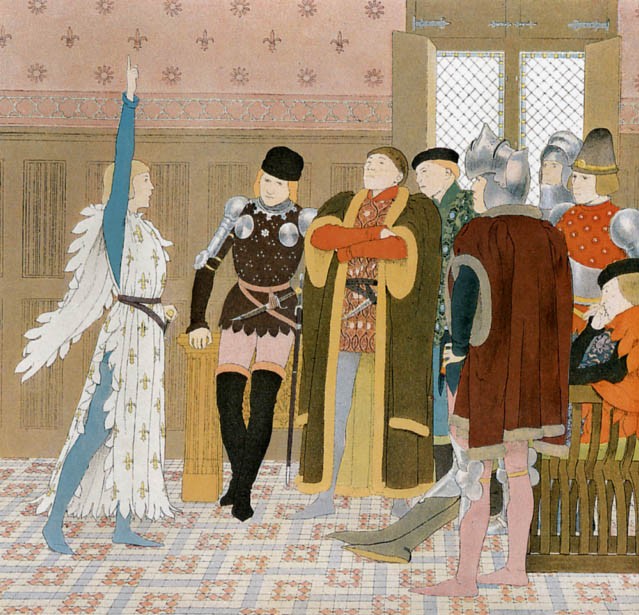
The first brilliant biography for children of the Maid of Orléans was written by another resident of the city, Maurice Boutet de Monvel (1850–1913). A student at Ecole des Beaux-Arts in Paris; Boutet de Monvel, an academy painter, needed to augment his income. Hence he began to create children’s books and contribute illustrations to Century and Scribner’s, as well as the French edition of St. Nicholas, the famous magazine for boys and girls. But his interest in French history led him to write and illustrate his masterpiece, first published in Paris in 1896, The Story of Joan of Arc. Normally, I am a whole book critic—text and art have to work equally well for me to love a book. No one can possibly defend Boutet de Monvel’s text. He was neither a writer nor a historian—but he was one of the great French artists of his period. The illustrations in this book are best used alone to present Joan of Arc’s life.
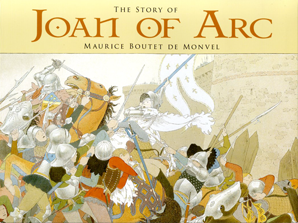
And what incredible images they are. Gerald Gottlieb, in the introduction to the book, argues that the rich detail in the book is reminiscent of early fifteenth-century illuminated manuscripts. They contain muted tones and the flat color found in Japanese prints. As Boutet de Monvel himself said about his art: “It is not color really, it is the impression, the suggestion of color.” As the artist depicts Joan, he blends modern elements with the medieval. Even on the title page, she leads French soldiers wearing the uniform of 1896. This artwork displays processions and vast panoramas, stirring scenes of battles and of Joan’s bravery.
Only a few first editions of the book exist, and the copy owned by the Pierpont Morgan Library was used to create the paperback volume of the book now available. Anyone who loves children’s book illustration—and wants to think about how books can be executed with the finest artistry—should pick up a copy of Boutet de Monvel’s Joan of Arc. As an artist, he represents those important words of Walter de la Mare, “only the rarest kind of best in anything can be good enough for the young.”
Here’s a page from The Story of Joan of Arc: