Daily children’s book recommendations and events from Anita Silvey.
Discover the stories behind the children’s book classics . . .
The new books on their way to becoming classics . . .
And events from the world of children’s books—and the world at large.
Find a Book!
Search the archives for recommendations by age group, book type, subject, date, and more.


July has been designated Make a Difference to Children month. All involved with children’s books celebrate this cause year round. Nothing can make more of a difference than the right book for the right child at the right time. I’m going to look at two novels this month, one classic and one contemporary, that that can change a child’s life.
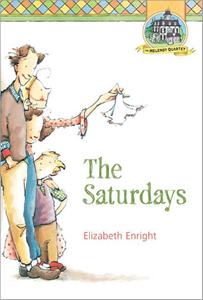
In Everything I Need to Know I Learned from a Children’s Book, both movie critic Roger Ebert and Newbery winner Linda Sue Park have written about Elizabeth Enright’s The Saturdays as the book that most influenced their lives. The niece of architect Frank Lloyd Wright, Enright studied dance with Martha Graham and illustration at the Art Students League of New York and Parsons The New School for Design. The multitalented Enright discovered she actually liked writing books more than she like illustrating them. In 1939 when she won the Newbery Award for Thimble Summer, she became one of the youngest writers to receive the honor. She is remembered today not for that Newbery but for the series of books called the Melendy Quartet, which begins with The Saturdays.
The four Melendy children—Mona, Rush, Miranda, and Oliver—live with their widowed father and a housekeeper in a New York City brownstone. Quite inventive, the group decides to pool their allowance money. That way one Saturday every month, each of them can do something quite unusual and special. Although the children must practice economy, they can enjoy New York in all its opulence. Randy goes to the art museum; Rush attends the opera; Oliver experiences the circus; Mona goes to the hairdresser. Enright excels at telling details in her work. For instance, when she describes Randy’s tea at the hotel she writes, the petit fours have “frilled paper collars…with silver peppermint buttons on top.” Now, who wouldn’t want to have one of those? One of their adventures ultimately leads to a wealthy patron asking them to spend the summer at a lighthouse she just happens to own. A wonderful blend of realism and fantasy, The Saturdays and its sequels feature four protagonists that children want either to be or have as friends. As Enright herself wrote, the books have been crafted out of “wishes and memory and fancy.”
The Melendy Quartet taught film critic Roger Ebert that stories could be wonderful; and many who have encountered these books over the years agree. The series was recently given attractive new covers for the paperback editions. So if you want to make a difference in the life of a child, pick up these books—or any of the others that you favor—to share with them this summer.
Here’s a passage from The Saturdays:
“Listen, Rush. Each of us (except Oliver, of course) gets fifty cents allowance every Saturday. Now. You want to go to Carnegie Hall and hear some music. Mona wants to go to a play. I want to see those French pictures Father was talking about. Every single one of those things costs more than fifty cents. Now what I was thinking was this. We’re all old enough to be allowed to go out ourselves—except Oliver—if we promise to be careful and not get run over or talk to people or anything. So why don’t we put all our allowances together once a week and let one of us spend them? I mean, for instance, Mona would get a dollar and a half next Saturday and she could go to a play. Then the next week you’d get it, and the week after that it would be my turn. See?”
Other books for this day
Also recommended:
- All of the Melendy Quartet books by Elizabeth Enright
Additional Information
A few other events for
- Happy birthday Brian Selznick (The Invention of Hugo Cabret) and Laura Numeroff (If You Give a Mouse a Cookie).
- It’s the birth date of Peggy Parish (1927-1988), the Amelia Bedelia series.
- Woody Guthrie (1912-1967) was born on this day. Read This Land was Made for You and Me: The Life and Songs of Woody Guthrie by Elizabeth Partridge.
- In 1946, Dr. Benjamin Spock’s Common Sense Book of Baby and Child Care is published. Read Everywhere Babies by Susan Meyers, illustrated by Marla Frazee, Owl Babies by Martin Waddell, illustrated by Patrick Benson, and Princess Baby by Karen Katz.
- Happy Bastille Day to our French friends. Read The Queen of France by Tim Wadham, illustrated by Kady MacDonald Denton.