Daily children’s book recommendations and events from Anita Silvey.
Discover the stories behind the children’s book classics . . .
The new books on their way to becoming classics . . .
And events from the world of children’s books—and the world at large.
Find a Book!
Search the archives for recommendations by age group, book type, subject, date, and more.

In February we celebrate American History Month. When I was a child, I was almost exclusively educated about American history through a series of books, with reddish-orange spines, that told stirring tales about our heroes and heroines. The series was Landmark Books, with titles such as Sterling North’s Abe Lincoln: Log Cabin to the White House. I still remember how these books smelled and their exact place, two shelves down, in my school library. As an adult I have revisited these titles and found them a bit wanting in terms of scholarship—but these writers knew how to create scenes, drama, and characters. They made history exciting.
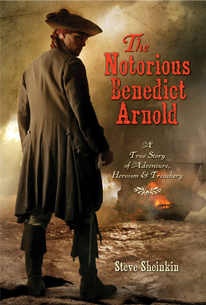
When I picked up Steve Sheinkin’s recent book The Notorious Benedict Arnold: A True Story of Adventure, Heroism, & Treachery, I was reminded of why the Landmark Books worked so well. But in this case, Sheinkin has done his research. He has a fine scholarly grasp, great sources, and effective footnotes. Sheinkin reveals Benedict Arnold as a man of action and adventure.
Now, I admit, I love the bad boys of history—always have, always will. (Don’t ever get me started on Richard III.) So Arnold is a personal favorite, and I have read scores of books about him. Both Jim Murphy and Jean Fritz have written great Arnold biographies for children, but The Notorious Benedict Arnold adds something new to what is available. Arnold was always restless when not in the height of action, and so is his biographer. Sheinkin begins his saga with the hanging of another one of our bad boys—John André. He quickly moves through Arnold’s early years and follows him out on the battlefield. Readers watch Arnold seize Fort Ticonderoga “in the name of the Great Jehovah and the Continental Congress”—what a line. He hacks his way through the wilderness in an attempt to capture Quebec. He outsmarts the British fleet in the Battle of Valcour Island. In his greatest moment Arnold defies General Gates’s orders and helps the Patriots win the Battle of Saratoga, the turning point in the American Revolution because it brought French aid for the Americans.
Although Sheinkin doesn’t try to glamorize Arnold during these triumphs, neither does he demonize him. Readers can see Arnold as his contemporaries viewed him—a man of action, who gave money, his physical health, and everything he had for the American cause. Had Arnold decided to accept Washington’s offer to lead half of the Continental army, he would be revered today and might well even have become president. Sheinkin does not dwell on the reasons why Arnold became a traitor, but he plays out in full measure the dramatic scene of Arnold’s attempt to hand over West Point, with George Washington present, to the British.
If you have young readers ages ten to fourteen who love American history with military action and adventure, The Notorious Benedict Arnold will keep them enthralled from the striking jacket cover to the final lines. It reminds all of us that history can be exciting and fun to read. That is what I learned from the Landmark Books—and once again from Steve Sheinkin.
Here’s a passage from The Notorious Benedict Arnold:
The night was dark and moonless. Each captain lit a low flame in a lantern and covered the sides of the lantern with cloth, making the faint light visible only from directly behind. One lantern was hung at the back of each boat. The men wrapped shirts around the ships’ oars to muffle their sound, and, very gently, dipped the oars into the lake.
Colonel Edward Wigglesworth led the way, and the other captains followed in single file, each guided by the dim light on the boat ahead. Amazed and breathless as he glided past the British ships, Wigglesworth could easily hear sailors talking, carpenters hammering. “We rowed out clear of the enemy without being discovered,” he said.
Arnold, on the Congress, was the last to leave.
Other books for this day
Also recommended:
- The Real Benedict Arnold by Jim Murphy
- Traitor: The Case of Benedict Arnold by Jean Fritz
Additional Information
A few other events for
- Happy birthday Cynthia Voigt (Dicey’s Song, A Solitary Blue), True Kelley (Claude Monet: Sunshine and Waterlilies), Iain Lawrence (The Giant-Slayer), and Woodleigh Hubbard (C Is for Curious).
- It’s the birth date of Frank Bonham (1914–1988) Durango Street, and Anthony Burgess (1917–1993), A Clockwork Orange.
- It’s the 25th Annual Texas Cowboy Poetry Gathering. Read Home on the Range: Cowboy Poetry selected by Paul B. Janeczko, illustrated by Bernie Fuchs; Cowboy Slim by Julie Danneberg, illustrated by Margot Apple; and Cowboy Kate and Cocoa by Erica Silverman, illustrated by Betsy Lewin.