Daily children’s book recommendations and events from Anita Silvey.
Discover the stories behind the children’s book classics . . .
The new books on their way to becoming classics . . .
And events from the world of children’s books—and the world at large.
Find a Book!
Search the archives for recommendations by age group, book type, subject, date, and more.


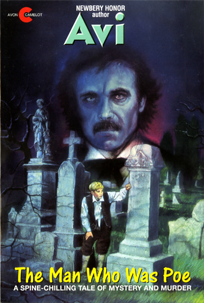
On January 19, 1809, Edgar Allan Poe was born in Boston, Massachusetts. At some time or another during childhood or adolescence, almost every child in America falls under his spell. I remember the first time my mother read me “The Raven;” later I became obsessed with his dark mysteries and macabre short stories. Poe only lived for a brief forty years, but he was the first well-known American writer who attempted to live on proceeds from his works as an author—resulting in a difficult, erratic financial life. Things haven’t changed much in two hundred years!
In 1989 Avi wrote a multilayered, haunting tribute to this literary master, The Man Who Was Poe. When working on the book, Avi resided in Providence, Rhode Island, and focused the novel on the brief period of time Poe also lived there, November 1848, while he was courting Mrs. Sarah Helen Whitman. From this period comes the daguerreotype of Poe most frequently reproduced, and at one point in the book, Poe goes to this studio to have this picture taken.
The story opens with Edmund and his twin, Sis, living alone in a tenement room, without food. Their caretaker, their aunt, has been gone for two days. Ignoring his aunt’s explicit instruction, Edmund leaves to find something for them to eat. When he returns, he faces his worst possible nightmare—his sister has vanished.
Running into a man who calls himself Dupin (Edgar Allan Poe), Edmund enlists his aid to find his aunt and sister. In fog-shrouded streets of Providence, with villainous creatures who haunt the docks, a tale of mystery and deception ensues. It is, in fact, just the type of tale Poe himself might have spun out of his fevered brain, involving trysts in a cemetery, ghosts, and a bank robbery. A reader almost has to outline the plot to keep track of all of the puzzles explored in the book. In the meantime, the story moves breathlessly along.
It is unclear, as can often be the case in post-modern novels, whether Poe himself is simply writing this story—or if events are happening, and Poe is trying to make a story out of them. Either way, readers learn about Poe’s life, the death of his beloved wife, Virginia (Sis), and his attempt to find a new wife and stabilize himself in Providence. All of these details are seamlessly woven into this mystery and suspense story. Often taught to fifth through seventh graders, the book definitely gives young readers the background they need if, and when, they become Poe addicts. Historical fiction, mystery, and horror, The Man Who Was Poe dishes them all out in equal measure.
Happy birthday Edgar Allan Poe; I will reread “The Raven” in your honor. As a child, I thought that the phrase “Quoth the Raven, ‘Nevermore,’” was one of the coolest lines written in the English language. I still do.
Here’s a passage from The Man Who Was Poe:
The old city lay dark and cold. A raw wind whipped the Street lamps and made the gas flames hiss and flicker like snake tongues. Fingers of shadow leaped over sidewalks, clawing silently upon closely set wooden house. Stray leaves, brittle and brown, rattled like dry bones along cold stone gutters.A man, carpetbag in hand, made his way up College Hill, up from the sluggish river basin, battling the steep incline, the wind, and his own desire. He was not big, this man, but the old army coat he wore–black and misshapen, reaching below his knees–gave him an odd bulk. His face was pale, his mustache dark, his mouth set in a scowl of contempt. Beneath a broad forehead crowned by a shock of jet black hair, his eyes were deep, dark, and intense.
Other books for this day
Also recommended:
- The Raven (Visions in Poetry) by Edgar Allen Poe, illustrated by Ryan Price
Additional Information
A few other events for
- Happy birthday Nina Bawden, Granny the Pag, and Pat Mora, Book Fiesta.
- In 1840, Captain Charles Wilkes completes circumnavigating Antarctica, claiming what became known as Wilkes Land for the United States. Read Antarctica: Journeys to the South Pole by Walter Dean Myers.
- It’s National Popcorn Day. Read The Popcorn Book by Tomie dePaola; Popcorn by Alex Moran, illustrated by Betsy Everitt; and The Ghost of Popcorn Hill by Betty Ren Wright, illustrated by Karen Ritz.
- It’s also Tin Can Day. Read The Tin Forest by Helen Ward and Wayne Anderson, and Gregory, The Terrible Eater by Mitchell Sharmat.