Daily children’s book recommendations and events from Anita Silvey.
Discover the stories behind the children’s book classics . . .
The new books on their way to becoming classics . . .
And events from the world of children’s books—and the world at large.
Find a Book!
Search the archives for recommendations by age group, book type, subject, date, and more.

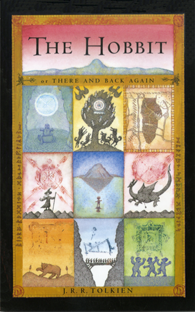
On September 21, 1937, a children’s book appeared in England that, like other English classics such as Stevenson’s Treasure Island, Potter’s Peter Rabbit, or Grahame’s Wind and the Willows, began as a story told to a specific child. Actually, the idea of the book came when the author, correcting 286 school exams, found a blank page in one of them. He wrote simply “In a hole in the ground there lived a hobbit,” and then J.R.R. Tolkien set out to discover what hobbits actually were. He started telling his three sons stories about a small being with furry feet, creatures of small imagination but great courage, the kind of courage he had seen in the trenches in World War I. In the story, Bilbo Baggins, a comfort-loving hero, sets out from his home with a band of dwarfs to seek the treasure guarded by a dangerous, fire-breathing dragon. Over a period of nearly three years, Tolkien developed this unlikely hero’s journey, crafting one of the greatest fantasies ever written.
The Hobbit experienced a charmed life in terms of publication. Even before Tolkien had finished the book, the editors at Allyn and Unwin knew of its existence and pursued the author. Raynor Unwin, the ten-year-old son of the chairman of the firm, was paid a shilling for reading the manuscript and giving his opinion. He wrote what is believed to be the first children’s response to the book: “This book with the help of maps does not need any illustrations…it is good and should appeal to all children between the ages of 5 to 9.” Obviously, young Raynor thought himself a bit superior to the contents, which might be best appreciated by younger children. Today The Hobbit usually gets classified as a novel for children ages ten through fourteen. Tolkien himself believed the book needed both maps and illustrations, and he also designed a book jacket decorated with runes, a language that he invented.
The book quickly became a bestseller in England, as well as in the United States when it appeared in 1938. A mere month after the publication, Stanley Unwin discussed the idea of a sequel with the author—and Tolkien set to work. But it would not be until 1951 that he completed his thousand-page extension of these sages: the Lord of the Rings trilogy. At one point in The Hobbit, Gandalf the wizard says to Bilbo, “You are a very fine person, Mr. Baggins, and I am very fond of you; but you are only quite a little fellow in a wide world after all.” But this little fellow has found millions and millions of fans in the wide world since he first appeared seventy-four years ago.
Happy birthday The Hobbit. Thank you for reminding us that a small fellow, or child, can go on to do great things.
Here’s a passage from The Hobbit:
The hobbit was a very well-to-do hobbit, and his name was Baggins. The Bagginses have lived in the neighbourhood of The Hill for time out of mind, and people considered them very respectable, not only because they never had any adventures or did anything unexpected: you could tell what a Baggins would say on any question without the bother of asking him. This is a story of how a Baggins had an adventure, and found himself doing and saying things altogether unexpected. He may have lost the neighbours’ respect, but he gained—well, you will see whether he gained anything in the end.
Also recommended:
- The Lord of the Rings by J.R.R. Tolkien
Additional Information
A few other events for
- Happy birthday Stephen King (The Girl Who Loved Tom Gordon), Hans Wilhelm (I’ll Always Love You), Robin L. LaFevers (Theodosia and the Serpents of Choas) and Hazel Edwards (Stickybeak).
- It’s the birth date of H. G. Wells (1866-1946), The War of the Worlds, Taro Yashima (1908-1994) Crow Boy, Umbrella, and Alexander Key (1904-1979), Escape to Witch Mountain.
- In 1897 the New York Sun runs an editorial response to a girl’s letter about the existence of a Jolly Man in Red. Read Yes, Virginia, There Is a Santa Claus by Frances P. Church, illustrated by Joel Spector.
- In 1981, Sandra Day O’Connor becomes first woman to serve as an U.S. Supreme Court Justice. She also wrote the semi-autobiographical picture book Finding Susie, illustrated by Tom Pohrt.
- It’s World Alzheimer’s Day. Read The Graduation of Jake Moon by Barbara Park, and Figuring Out Frances by Gina Willner-Pardo.
- The United Nations has declared today an International Day of Peace. Read Peace One Day by Jeremy Gilley and Karen Blessen.