Daily children’s book recommendations and events from Anita Silvey.
Discover the stories behind the children’s book classics . . .
The new books on their way to becoming classics . . .
And events from the world of children’s books—and the world at large.
Find a Book!
Search the archives for recommendations by age group, book type, subject, date, and more.
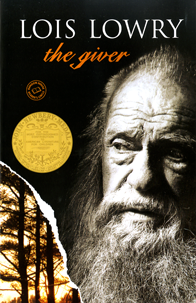
“It was almost December, and Jonas was beginning to be frightened.” With these words Lois Lowry opens the best novel for children of the 1990s and one of the greatest science fiction works of all time—The Giver.
In the early ’90s Lowry found herself a frequent visitor at a nursing home. There her mother, going blind, would relate tales of her life. Although in better physical shape, her father was slowly losing his memory. He would look at pictures of Lois’s sister, now dead, and ask how she was doing.
Then while taking her grandson on a Swan Boat ride in Boston Public Garden, the young boy said to her, “Have you ever noticed that when people think they are manipulating ducks, actually the ducks are manipulating people?” As she thought about this comment, her parents, and her own life, she began to wonder what kind of world the next generation of children would inherit.
In The Giver, Lowry began to write about what she thought was a utopia for those children of the future. This world appears to have solved all problems—poverty, inequality, loneliness, and old age. Children are carefully trained for their future occupation, chosen by the community. Families raise a controlled number of children and follow strict rules. But slowly as Lowry worked on the book, she grew to realize the dark side of this world. One of the most powerful moments of The Giver comes when the reader understands the high price of this system: a small child is killed without emotion or remorse.
The protagonist, twelve-year-old Jonas, has been given his assignment for his future work—to serve as the apprentice for The Giver, who keeps the memories of the community. In the process of receiving these memories, Jonas begins to realize that his community has made certain choices, ones that make him increasingly uncomfortable. A young man of great heart and social conscience, Jonas finally realizes that he can no longer stay; he must flee and try to get himself and his brother Gabe to another community.
One of the greatest strengths of this book, perfect for the classroom or book group, has always been its ambiguous ending. The last line—“But perhaps it was only an echo”—leaves every reader with a slightly difference sense of how the story ends. Although the author herself has always insisted that she provided a happy, optimistic ending, in that sentence she left room for each person to bring their own sensibility and opinions.
Lowry has always had the greatest respect for her audience, believing children capable of understanding complex issues. Hence, she challenged them in The Giver to think about the society presented in the book and their own world. This provocative and haunting book lingers in the memory of all those who pick it up—one of those rare books that changes the way its readers look at reality.
Here’s a section from The Giver:
It was almost December, and Jonas was beginning to be frightened. No. Wrong word, Jonas thought. Frightened meant that deep, sickening feeling of something terrible about to happen. Frightened was the way he had felt a year ago when an unidentified aircraft had overflown the community twice. He had seen it both times. Squinting toward the sky, he had seen the sleek jet, almost a blur at its high speed, go past, and a second later heard the blast of sound that followed. Then, once more time, a moment later, from the opposite direction, the same plane.
Also recommended:
- Gathering Blue by Lois Lowry
- Messenger by Lois Lowry
Additional Information
A few other events for
- Happy birthday, Grace Andreacchi (Little Poems for Children).
- It’s also the birth date of Joseph Conrad (1857–1925), Heart of Darkness.
- In 1847, abolitionist movement leader Frederick Douglass publishes first issue of newspaper North Star. Read Frederick Douglas: A Noble Life by David Adler.
- It’s National Roof over Your Head Day, an opportunity to appreciate all that we have starting with shelter that protects us from the elements. Read Let’s Go Home: The Wonderful Things About a House by Cynthia Rylant, illustrated by Wendy Halperin. And today is Take Your Child to a Bookstore Day. I hope all Almanac readers do!