

April has been designated National Gardening Month. The mere idea of gardening brings me joy. As I write the first draft of this essay in February, two feet of snow sit outside the window. Will I ever see my gardens again? Gardening month reminds me of that desperate plea from Mary Lennox in The Secret Garden, “Might I have a bit of earth?”
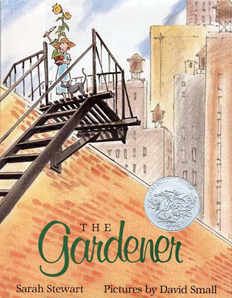
Organizers of National Gardening Month suggest sharing plants with friends and planning a community clean-up. Before you get started, you might want to pick up a book that will inspire you, Sarah Stewart’s The Gardener, with illustrations by David Small. Certainly one of the most satisfying picture books of the last fifteen years, the text of this Caldecott Honor Book is presented in letters from a young girl Lydia Grace Finch circa 1935.
Readers first see Lydia on the endpapers, picking tomatoes with her grandmother in a lush country garden. Lydia has been summoned to city to live with her uncle Jim, until things get better for her family hit hard by the Depression. Lydia leaves King Mill on a train, carrying packets of seeds from her grandmother. When she arrives in the city, the dark, unlovely railroad station looms over her. An optimist, Lydia notices window boxes and beams of light. Although her uncle Jim does not smile, she writes him poetry and learns to work in his bakeshop, kneading bread. But Lydia is a gardener at heart, not a baker. In this impoverished environment, she finds a secret place to ply her craft: the apartment building roof. Vacant lots provide the necessary dirt; cracked teacups and bent cake pans become the vessels for her dreams.
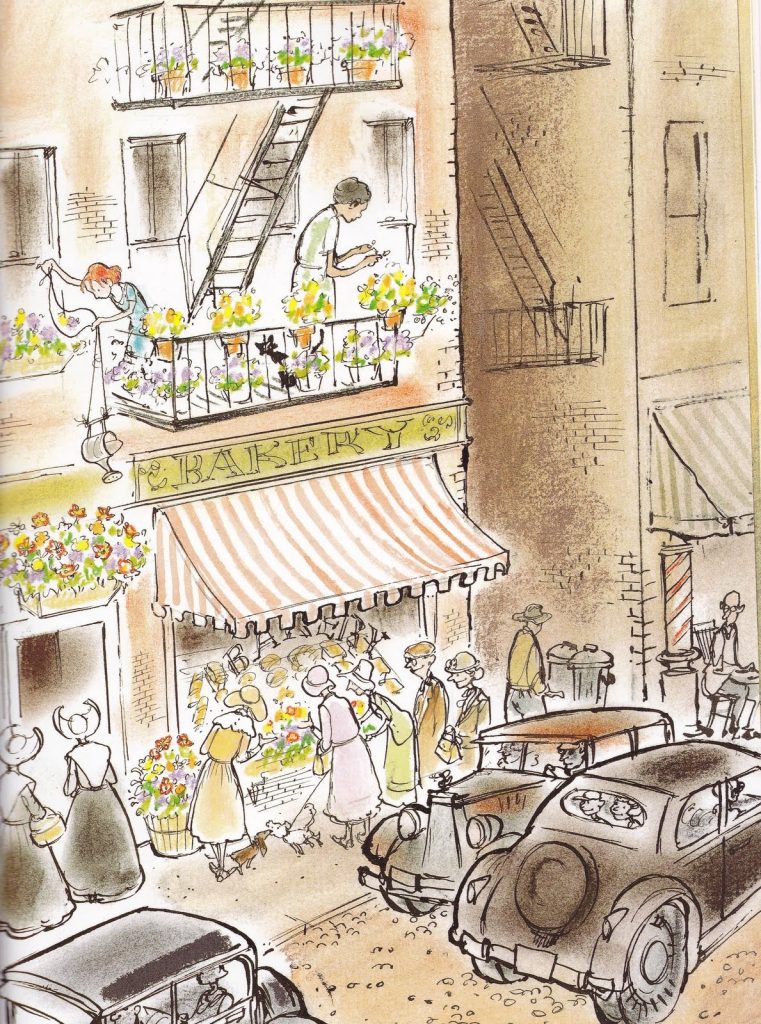
Lydia also spruces up her uncle’s bakery, planting tulips, radishes, onions, and lettuce in the window boxes that adorn the shop. Finally, she shows her rooftop garden to grumpy Uncle Jim, a once-grimy place now transformed into a beautiful patio garden. After Lydia’s father finds a job, this no-longer unhappy man hugs his niece as he sends her back to her home and the garden and people she longs for.
A totally satisfying story in itself, The Gardener is brilliantly illustrated. In watercolors with a strong black line, David Small set scenes and shows what characters feel, even when those emotions are not described in the text. The transformation of useless city space to a splendid garden satisfies readers every time as they watch it happen.
When this book appeared in 1997, I thought it a wonderful re-creation of the Depression Era for children. Now it seems to me an even more important book. With children who might well identify with a parent out of work or having little money, the book speaks to the true American can-do spirit. Make beauty where none exists; plant victory gardens; transform useless landscapes into those that produce food and joy; reuse and recycle. The Gardener can be used to talk about all of these contemporary issues. It continues to send its readers off to find that “bit of earth,” whether in vacant lots, window boxes, or well-laid-out garden beds.
Here’s a page from The Gardener: