Daily children’s book recommendations and events from Anita Silvey.
Discover the stories behind the children’s book classics . . .
The new books on their way to becoming classics . . .
And events from the world of children’s books—and the world at large.
Find a Book!
Search the archives for recommendations by age group, book type, subject, date, and more.
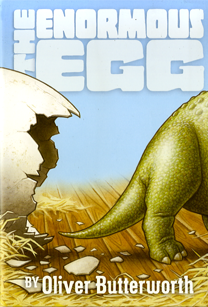
April has been designation National Humor Month. Many children tell adults that they just want funny books. One of my favorites in this category, Oliver Butterworth’s The Enormous Egg was created in 1956 and concerns a favorite topic of children: dinosaurs.
Nate Twichell, an ordinary boy in Freedom, New Hampshire, helps on the family farm and in his father’s printing press for the local paper (circulation 800). One day his chicken lays an enormous egg; Nate and his father carefully tend it for six weeks. And then, surprise! A baby Triceratops, which Ned names Uncle Beazley, hatches and begins to eat his way through the Twichell farm, doubling his weight every few days. A visiting scientist from Washington, D.C. gets involved, and eventually Congress has their say before Ned’s companion finds a permanent home in the National Zoo. I hadn’t read this book for years and was struck, as an adult, by Butterworth’s cynicism about congressmen. It almost makes the book seem contemporary.
Butterworth’s archives at the Thomas Dodd Center at the University of Connecticut reveal that he hoped to illustrate his own novel, only to have editor Dudley Cloud of the Atlantic Monthly put a kibosh on that idea. Butterworth then expressed the hope that Garth Williams, who had so magically illustrated Stuart Little, might be employed. In the end Louis Darling illustrated the book and was paid the extravagant fee of $1,000—causing the publisher to express consternation at the expense. After all, Butterworth himself had only been given $500 in advance for this whimsical story.
A year after the book’s release, the publisher was no longer complaining; the book had sold 4,820 copies, “which ain’t hay, hooray.” In print ever since, the book has gone on to win scores of admirers. At one point Butterworth’s editor had hopes for television adaptation, but told his writer: “It wouldn’t surprise me if you don’t believe in TV.”
Well, Butterworth did believe in creating an engaging character that children would admire and emulate. Who wouldn’t want to raise a dinosaur from an egg? Although the plot is, of course, nonsensical, Butterworth presents it in such a believable way that young readers and parents are taken along for the ride. Like Jurassic Park, The Enormous Egg rests on the fantasy that dinosaurs and humans could cohabit this planet. Even if we haven’t yet figured out how, it still feels good to laugh at this saga, the perfect read-aloud for ages six through ten.
Here’s a passage from The Enormous Egg:
Taking care of that egg was an awful chore. The trouble was that the thing was so big that the poor hen couldn’t handle it. You see, when a hen sits on her eggs, she keeps turning them over every now and then so they’ll get warmed evenly all around. I guess everyone must know that anyway, but Pop says when you’re writing something you can’t take anything for granted, because you never know who might read it. So if I start explaining something you know about already, just skip that part and go on. I suppose there might be somebody who’d lived in a city all his life, and he wouldn’t know too much about how a hen takes care of her eggs and things like that.
Other books for this day
Also recommended:
- The Trouble with Jenny’s Ear by Oliver Butterworth, illustrated by Julian De Miskey
Additional Information
A few other events for
- Happy birthday Fred Brenner (The Drinking Gourd), Maya Angelou (Life Doesn’t Frighten Me), Johanna Reiss (The Upstairs Room), Elizabeth Levy (My Life as a Fifth-Grade Comedian), and Joan Leslie Woodruff (The Shiloh Renewal).
- It’s the birthdate of Glen Rounds (1906–2002), The Blind Colt, and Phoebe Gilman (1940–2002), The Balloon Tree.
- Happy birthday Los Angeles, incorporated as city in 1850. Read Weetzie Bat by Francesca Lia Block and City of Angels by Tracie Peterson and James Scott Bell.
- It’s School Librarian Day. Read Lunch Lady and the League of Librarians by Jarrett A. Krosoczka.