

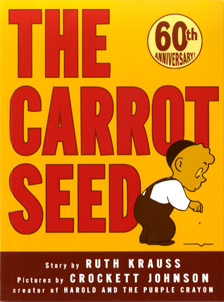
In May of 1945—around the time of Victory in Europe Day in World War II—a small book appeared on the list of Harper and Brothers. A quirky, offbeat title, it was not advertised that year and did not seem a likely candidate for celebrity status in the picture book world. But when it comes to children’s books for the very young (those one to three years old), simplicity often wins out over other approaches, and The Carrot Seed exemplifies simplicity.
The creation of writer Ruth Krauss, this small gem stands as a testament to revision. When asked how long it took her to write The Carrot Seed, Krauss always said “her whole life.” She had to pare the story down, again and again, until she got its essence.
In this saga, a young child plants a seed. Everyone else believes it won’t grow (or as they say, “come up”) except the child. “And then one day,/a carrot came up/just as the little boy had known it would.” A statement about childhood belief and faith, the book—sometimes called “the little book with the big idea”—has become one of our most cherished American picture books.
Krauss could be quite acerbic when she wanted to, and even her editor Ursula Nordstrom addressed her in letters as “Dear Ruthless.” Krauss often terrorized her illustrators. On one notable occasion she took some drawings offered her by a frightened, young illustrator and deposited them in a wastebasket. But she pronounced the drawings for The Carrot Seed “perfect.”
Of course, Krauss was married to the illustrator of this book, David Johnson Leisk, aka Crockett Johnson who also created Harold and the Purple Crayon. But it would be hard to image any other rendition of this book or of the child in the drawings. Johnson, who was himself bald, always drew bald characters or, in the case of The Carrot Seed, a child with a single hair. He maintained that bald heads were easier to draw than ones with hair.
Happy birthday to The Carrot Seed. For all these years, children have been absorbing its subtle message about the power of positive thinking.
Here’s a page from The Carrot Seed:
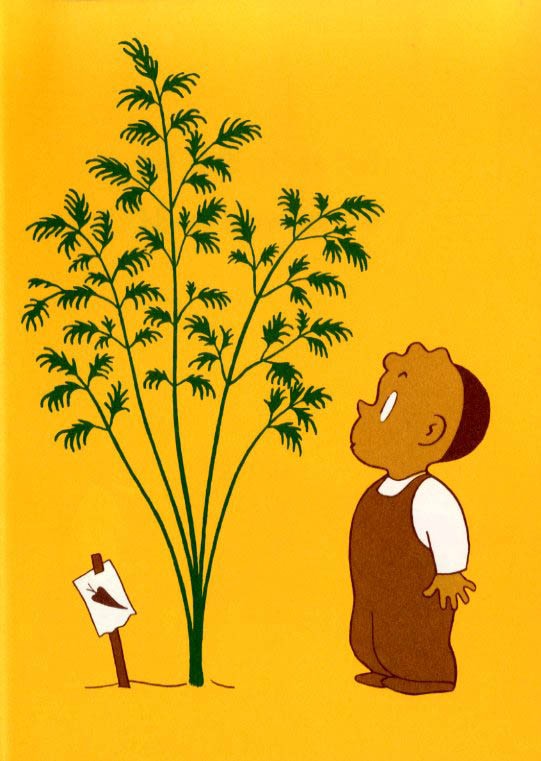
And then, one day,
a carrot came up
just as the little boy
had known it would.