
From 2011-2015 the sesquicentennial of the Civil War will be celebrated. Although the war began 150 years ago, so many contemporary issues can be discussed with children using the Civil War as a starting place. So over the next year I will highlight some of the best books about this era for young readers.
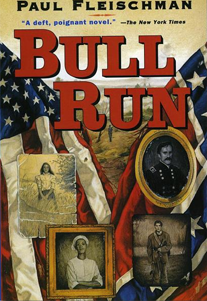
July 21 marks the first battle in the war—the South called it the Battle of First Manassas and the North, the First Battle of Bull Run. Picnickers came from Washington, D.C., with hampers of food and champagne to watch the grand spectacle. Untrained Union and Confederate troops experienced brutal conflict for the first time. In 1993 Newbery winner Paul Fleischman published an amazing work of fiction, Bull Run. Winner of the Scott O’Dell Award for Historical Fiction, the story is narrated by sixteen different characters who experience the events that day. Union and Confederate, black and white, male and female, from alternating points of view they reveal their hopes for the battle, and its grim realities. Ideal for Readers’ Theatre, the book works best if read independently by those who know something of Civil War history and the details of the battle. One of Fleischman’s finest pieces of writing, Bull Run is powerful, beautifully crafted, spare, and haunting; it captures how individuals experienced the horrors of the Civil War.
While Fleishman’s Bull Run is best for a more knowledgeable reader, Michael Hempill and Sam Riddleburger’s 2009 book, Stonewall Hinkleman and the Battle of Bull Run, is perfect for the average young reader who knows little of the Civil War. I picked this book up recently because I wanted to look at the work of Riddleburger, the nom de plume of Tom Angleberger who wrote The Strange Case of Origami Yoda and found that his earlier book fills a tremendous gap in Civil War literature.
The son of fanatic Civil War reenactors, Stonewall Hinkleman finds himself carted around by his parents to various events. He hates having to wear hot scratchy uniforms and being deprived of contemporary electronic games. At Bull Run, he finds himself transported back to the real battle, where he needs to keep another reenactor from changing history forever. For adults who love Harry Turtledove’s The Guns of the South or for young readers who are just being introduced to the Civil War, Hemphill and Riddleburger provide a lot of action, excitement, and details of the actual battle. Anyone can come to this book, gain information, and turn the pages breathlessly because they want to find out what happens. The book makes a great introduction to the Civil War for any third through seventh grade child you might be dragging to a Civil War battlefield this summer.
If you haven’t ever gone to see some of the hallowed ground of the Civil War, both books together might convince you that you should. Only then do you truly understand the fragility and the importance of the phrase, “The United States of America.”
Here’s a page from Bull Run by Paul Fleischman:
 Colonel Oliver Brattle
The booming jerked me out of sleep, woke the dishes and set them chattering, and sent Clara dashing through the dark to the children. “Must be the Lord comin’!” cried one of the servants. I realized I’d been dreaming of Mexico. Strange.
I lit a candle. The clock read four thirty. All of Charleston seemed to be in the streets. I dressed, stepped out the front door, and was embraced at once by a teary-eyed stranger. “Praise the day!” he shrieked into my face. “they’re firing on Fort Sumter!”
We gathered on Judge Frye’s flat roof. The cannons rattled the very constellations. Shells sailed, their lit fuses tracing caliper-perfect arcs, then exploded. Each illumination of the bay was greeted with appreciative oohs and hurrahs. You’d have thought that the crowds were enjoying a Fourth of July display. Some brought basket of food to the rooftops and raised glasses in toasts to South Carolina, Jefferson Davis, and General Beauregard. I was silent, though I shared their allegiance. I’d fought, however, fourteen years before from Veracruz to Mexico City. I remembered well what shells do to living flesh, and felt in melancholy mood. Amid all the cheering, the Negroes were similarly glum–suspiciously so. If they rejoiced that a war that might break their bonds had begun, they dared let no one discern it. By a bursting shell’s light, I eyed Vernon, my body servant. He caught my glance and the slimmest of smiles fled his lips, like a snake disappearing down a hole.