

While I was vacationing in the Rangeley Lakes area of Maine in October a sign caught my eye: “Wilhelm Reich Museum.” Although I could not get in, I was intrigued to see the location of the laboratory of the radical psychoanalyst who worked with Sigmund Freud. While there I thanked him silently for his little-known contribution to children’s literature: He treated and inspired William Steig.
William Steig was born on November 14, 1907. As a young man Steig sought out Wilhem Reich for psychological treatment and, like other devotees, spent time in Reich’s boxes, the orgone energy accumulators. When I interviewed Steig, then in his eighties, he spoke fondly about his experiences in the orgone box and expressed the wish that I might be able to sit in one some day. He had found the experience liberating.
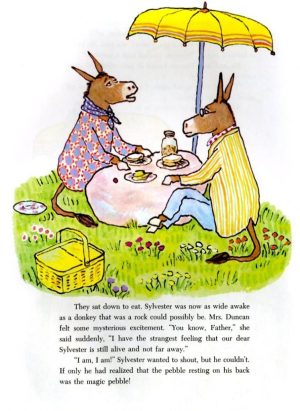
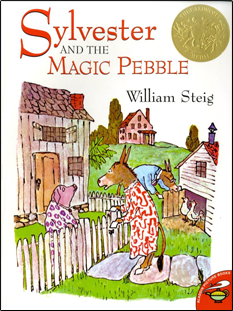
Although I didn’t get to visit the Wilhelm Reich Museum or sit in an orgone box (much to my dismay), I did reread Sylvester and the Magic Pebble in Steig’s honor. Sylvester, the donkey, finds a magic pebble, which grants his wishes. Unfortunately, while he is holding it he makes the wrong request and turns into a rock. Then Sylvester has to go through days and nights as a rock, until his father puts the magic pebble on the rock, and Sylvester, wishing to become his real self again, turns back into a donkey.
Steig’s first book for children, Sylvester and the Magic Pebble was created at the insistence of a New Yorker colleague, Robert Krauss. Krauss had started his own publishing company and thought Steig’s sensibility was just right for children. After the book won the Caldecott Medal, Steig himself began to believe that he could create books for children and did so until his death in 2003. Even the books written and illustrated in his eighties, like Pete’s a Pizza, show a remarkable youthful spirit.
During the politically charged seventies, Sylvester and the Magic Pebble got into some hot water. In the book Steig portrays the police as pigs, and some people took offense. Steig always liked to point out, however, that his main protagonists were donkeys! Even in his eighties he felt badly that as a newcomer to the field, not accustomed to public speaking, he gave a very brief Caldecott acceptance speech, which offended some member of ALA. Now, of course, all has been forgiven and forgotten. William Steig gave children of the world some of the freshest, funniest, most original picture books ever created. I like to believe that when working in this form he became his true self—the person he was always meant to be.
To become one’s real self is, of course, the goal of all patients in psychotherapy. Maybe this book, and all of Steig’s work, owe far more to Wilhelm Reich than I have ever realized.
Here’s a page from Sylvester and the Magic Pebble: