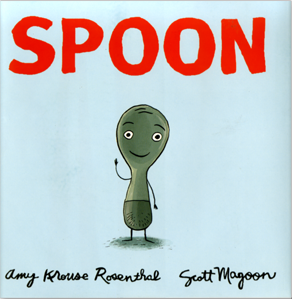
Today marks National Cereal Day, so raise a glass of milk or a cup of coffee to your favorite brand. Americans are, as group, addicted to cereal. I recently a saw a Facebook post by someone overseas who lamented she could not get her favorite American cereal in this foreign country. Our book of the day, Spoon by Amy Krouse Rosenthal, features a page with cereal—but its focus rests on the utensil that makes cereal eating possible.
Inanimate objects sometimes make great protagonists for children’s books—Mary Anne the steam shovel in Mike Mulligan and Little Toot the tugboat, to name a couple of stellar examples. Still it remains difficult to pull off a book about nonhuman or nonanimal protagonists successfully. Readers don’t naturally identify with a spoon—unless the author and illustrator are very clever.
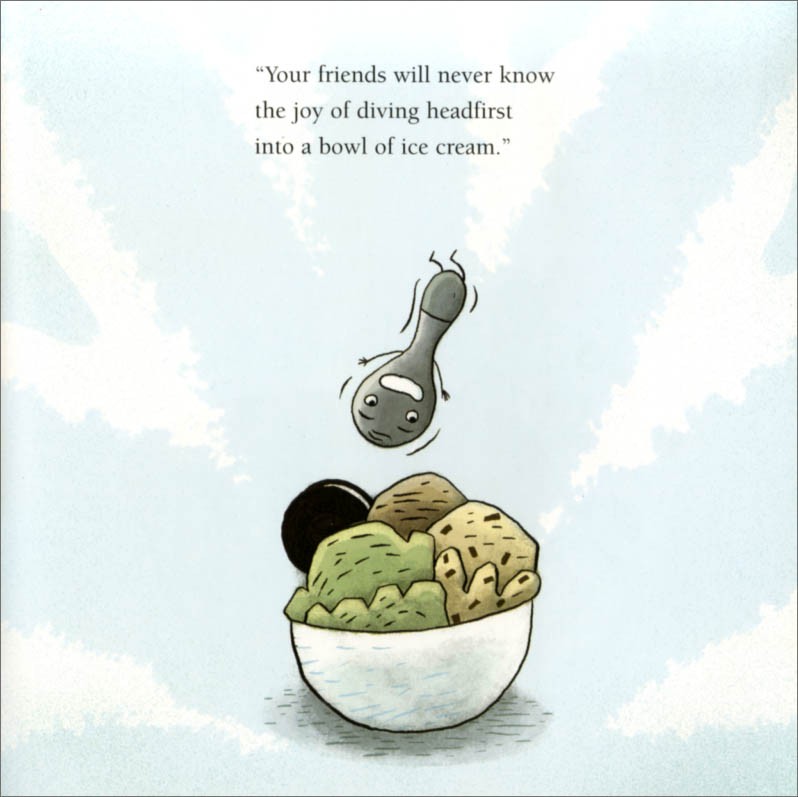
We first meet Spoon and Spoon’s family (who have been patterned after real collectible spoons—wooden, slotted, salt, and souvenir) via a fabulous double-page spread of all kinds of expressive and varied objects. Then the author sets out the dilemma. Although it would seem that the little spoon has a perfect life, he is feeling blue. Jealousy has set in—it seems to him that Fork, Knife, and Chopsticks have a better deal. Chopsticks in particular seem “really cool and exotic.” At night Mom gives the needed perspective when tucking the small utensil into bed. His friends never get to dive headfirst into ice cream or clink against a cereal bowl. Later that night, when Spoon can’t sleep, he tucks himself into bed with the parents, as they nestle like spoons.
Krouse Rosenthal’s text, both spare and sweet, provides just the right amount of room for Scott Magoon to work his illustration magic. From endpapers showing Knife, Fork, Spoon, and Chopsticks to the final page of Spoon dreaming about all the things he can eat, every page has been given character, action, and emotional touches. Long before the end of the book, readers have done something extraordinary—they have grown to love a spoon! An art director in his day job, Magoon is a master at dividing text, keeping the pacing just right, alternating layouts, and moving readers to the next page. Ideal for even the youngest reader, Spoon has been used successfully for children nine months through five years. Fortunately for all its many fans, a companion volume, Chopsticks, was published in January.
I know when I pick up my spoon today to celebrate National Cereal Day, I’m going to check and see if it has an expressive eyes and mouth. I just wish this particular spoon family lived in my silverware box. Oh, well, at least they are alive in a very beguiling and satisfying picture book.
Here’s a page from Spoon: