Daily children’s book recommendations and events from Anita Silvey.
Discover the stories behind the children’s book classics . . .
The new books on their way to becoming classics . . .
And events from the world of children’s books—and the world at large.
Find a Book!
Search the archives for recommendations by age group, book type, subject, date, and more.


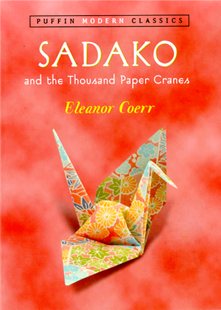
For two and a half weeks, through November 11, we celebrate World Origami Days. Why not try your hand at the Japanese folk art of paper folding that originated in the seventeenth century? During World Origami Days, I’m going to take a look at two novels that explore paper folding—one classic and one cutting edge.
The classic, Sadako and the Thousand Paper Cranes, was published in 1977, shortly after the end of the Vietnam War. Like so many other authors of historical fiction for children, Eleanor Coerr chose the time period of another conflict, World War II in the Pacific, to deliver her thoughts about the effects of war on children and her message of peace. As a journalist Coerr visited Japan for the first time in 1949 and spent three years interviewing the citizens about their post-World War II experience. After marrying a career diplomat and ambassador, she returned to Japan in the 1960s. At the Hiroshima Peace Park, she saw a new statue honoring Sadako Sasaki (1943–1955). Decorated with thousands of paper cranes, the memorial was engraved with these words: “This is our cry, this is our prayer: for building peace in the world.”
When she returned to the United States, Coerr became a children’s librarian and wrote books as well. For her eighth children’s book, she went back to Sadako’s letters, collected in an autobiography called Kokeshi, and presented the material in a straightforward manner so it could be read by children ages seven to ten.
Sometimes called the “Anne Frank of Hiroshima,” twelve-year-old Sadako was the star of the school running team, but her athletic prowess did not save her from contracting “the atomic bomb disease” leukemia. Sadako had once heard that paper cranes might cure illness: “If a sick person folds one thousand paper cranes, the gods will grant her wish and make her healthy again.” So she set out to fold that many, but died before they were finished. Her classmates completed the task for her and buried Sadako with a thousand paper cranes. In American schools, Sadako and the Thousand Paper Cranes is often accompanied by the folding of origami birds—instructions have been included in the book. In Japan on Peace Day, August 6, children place thousands of paper cranes on Sadako’s statue.
Today, October 25, marks the 56th anniversary of Sadako’s death. This slim book of eighty pages, written in very simple language, presents her heart-wrenching story. A three-handkerchief story, it will always work for those readers who request “a sad book”; it even ends with the line, “She never woke up.” By showing the effect of a war on the life of a vibrant and attractive child, Eleanor Coerr wrote a powerful book that advocates for peace.
Here’s a passage from Sadako and the Thousand Paper Cranes:
June came with its long, endless rains. Day after day the sky was gray as rain spattered against the windows. Rain dripped steadily from the leaves of the maple tree. Soon everything in the room smelled musty. Even the sheets felt clammy.
Sadako grew pale and listless. Only her parents and Masahiro were allowed to visit her. The bamboo class sent a Kokeshi doll to cheer her up. Sadako liked the wooden doll’s wistful smile and the red roses painted on its kimono. The doll stood next to the golden crane on Sadako’s bedside table.
Other books for this day
Also recommended:
- The Paper Crane by Molly Bang
Additional Information
A few other events for
- Happy birthday Stephanie S. Tolan (Surviving the Applewhites).
- It’s the birth date of Carolyn Sherwin Bailey (1875–1961), Miss Hickory, Fred Marcellino (1938–2001), Puss in Boots, and Hardy Boys ghostwriter Leslie McFarlane (1902–1977), pseudonym Franklin W. Dixon.
- John Steinbeck received the Nobel Literature Prize in 1962. His major works include The Grapes of Wrath, Of Mice and Men, Travels with Charlie, and The Pearl.
- It’s time for spaghetti silliness and macaroni mayhem on World Pasta Day. Read The Story of Noodles by Ying Chang Compestine and YoungShen Xuan, Pino and the Signora’s Pasta by Janet Pedersen, and Strega Nona by Tomie DePaola.