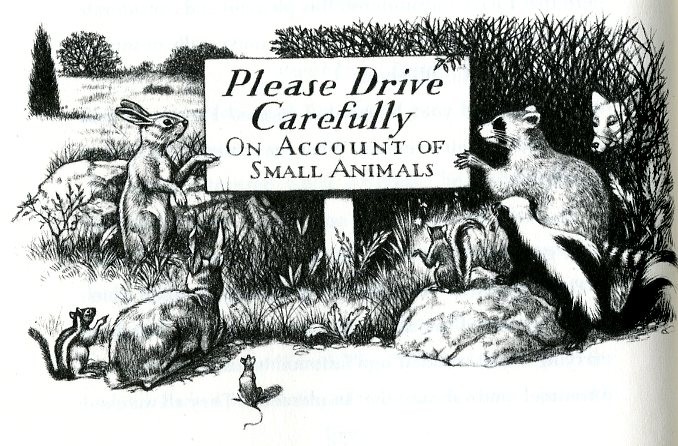


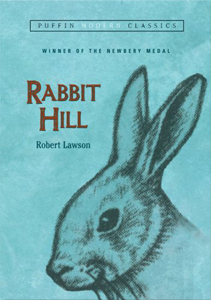
Today for National Rabbit Week, we’ll look at one of our timeless classics. The Newbery winner Rabbit Hill has been much loved from the time it was published in 1944, during the height of World War II, at least in part because it seems very contemporary in its concerns.
Robert Lawson was one of those rare creators who could write and illustrate with equal finesse. We have had only a few of these gifted individuals—people like William Steig. They are more rare than rubies. Lawson’s editor May Massee prodded him for some time to write a rabbit story about the house where he lived, “Rabbit Hill,” near Westport, Connecticut. Lawson chose to tell the story from the point of view of the animals who reside on the property. New owners are arriving, and Little Georgie, our rabbit hero, along with a woodchuck, fox, squirrel, fieldmouse, mole, skunk, deer, and other woodland creatures, find themselves both excited about the possibilities and worried about the consequences. In the final chapter, “There Is Enough for All,” Lawson outlines an early message of ecological interdependence. The simple story explores the complex idea of ecological diversity. It emphasizes how people need to share, get along with others, and cooperate.
As Lawson wrote about the rabbits on his property, he began to notice them behaving in peculiar ways. In fact, any time good news occurred about the book, a rabbit seemed to herald its arrival. One time a rabbit hopped with him to the mailbox, where he found a letter accepting the book. Later, he saw a rabbit sitting on the lawn, staring at him in the window. It had been months after the publication of the book, and Lawson thought nothing more could be happening to the book. How wrong he was. That day he received a letter congratulating him on the Newbery Award!
Lawson had won the Caldecott Medal for his 1941 book, They Were Strong and Good. To this day, he remains the only person to win both the Newbery and Caldecott Medals—an apt tribute for a man whose books have delighted those who read them for more than sixty-five years.
Here’s a passage from Rabbit Hill:
The sun had set, and the gold of the west slowly faded to a cool clear green. Venus, hanging low over the Pine Wood, burned brilliantly, all alone at first, but as the sky deepened the smaller stars began to show themselves. High up the new moon swam like a silver sickle.
As the dusk thickened the whole Hill began to whisper with the soft rustle of small bodies passing through the grass, with the swish of tiny feet, all making their way toward the garden, for this was Midsummer’s Eve and the Little Animals were gathering.