

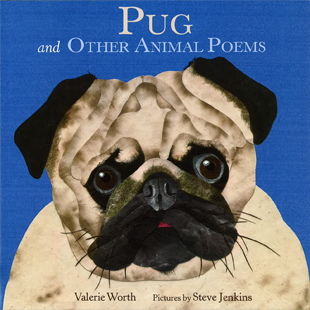
April is National Poetry Month; on the Almanac site I have already talked about one of my favorite books of poetry, Valerie Worth’s All the Small Poems and Fourteen More. Today let’s look at a picture book of Worth’s poems illustrated by Steve Jenkins, Pug and Other Animal Poems.
A graduate of Swarthmore who worked at Yale University Press, Worth (1933–1994) became known for her poetic observations about seemingly ordinary objects and about animals rendered in precise, compelling language. As she wrote about her process in Children’s Books and Their Creators: “The trick, of course, was to capture it whole and alive, to make its word self as true to its actual self as possible. . . That is where the language of poetry came into play, creating a unique, complex reality out of a wide array of adjectives and verbs, as well as nouns. But they had to be the right verbs, and the right adjectives, or else the object, the image, the subtle truth would fade away and be gone, and the magic would be gone as well.”
In Pug and Other Animal Poems, Valerie Worth demonstrates her ability to capture objects with just the right words, revealing a subtle truth and often magic. For the title poem, illustrated with a collage of a googled-eyed, adorable dog, Worth reveals things not only about pugs but also about humans: “With their googling/Eyes and stumpy/Noses, wrinkled/Brows and airy/Moles, they’re what/Some people/Might call plug-ugly;/Perhaps because, for/Dogs, they look/A lot like people.”
As she describes common animals—rabbits, fox, and dachshund—and sometimes a rare creature like a Bengal tiger, Worth plies her craft to capture each subject in a surprising and sometimes humorous way. Readers learn that the Dachshund, for instance, has “Plenty of/Legs at/Front and back/But nothing/Propping up/the Middle.”
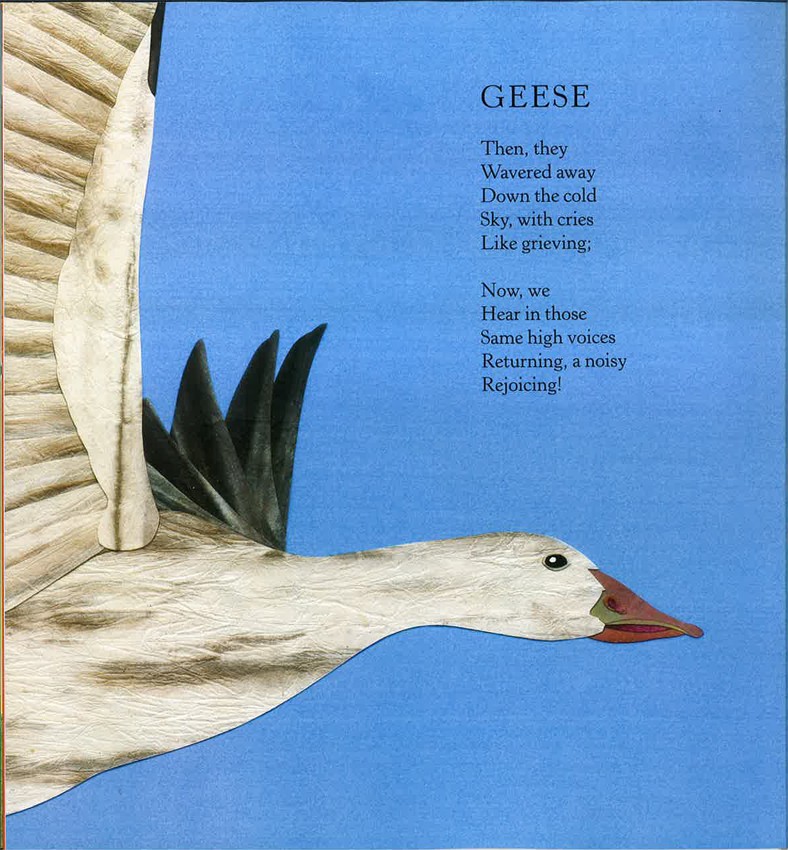
Steve Jenkins’s cut-paper collages give these creatures heft and weight. Sometimes they stare out of the pages at the reader like the Dachshund, or roar with ferocity like the Bengal tiger. Like Worth, Steve Jenkins has always been able to turn the ordinary into the extraordinary. Pleasing in its size and layout, Pug and Other Animal Poems can be used for a wonderful independent reading experience, or in a reading group or classroom.
This poetry, published twenty years after Worth’s death, could have been written yesterday—such is its strength and vitality. If you haven’t encountered Worth’s genius, pick up this book or the volume that preceded it, Animal Poems, and treat yourself to the work of a master.
Here’s a page from Pug and Other Animal Poems: