
On February 7, 1940, RKO Radio Pictures released the second Walt Disney animated film, Pinocchio. As a child who fell under its spell, I remember many of its virtues—cutting edge animation, Academy Awards for the Best Original Score and Original Song, “When You Wish Upon a Star,” and the delightful Jiminy Cricket. Hence, imagine my surprise when I actually picked up Collodi’s The Adventures of Pinocchio twenty years later and discovered that the film and the book share a title but little else.
Initially, they were closer in conception, but Disney felt that no one could sympathize with Collodi’s anti-hero, the wooden puppet with sawdust for brains and a penchant for getting into trouble. Disney wanted a hero plus comic relief, and so Pinocchio’s sidekick Jiminy Cricket entered the script. If you have not read this book, one of the most frequently translated stories in the world, you will find some surprises here. I have no doubt that were this book to be submitted today to publishers in the United States, it would be summarily rejected. It breaks just about every “rule” and then some.
Pinocchio first appeared as a magazine serial and became a book in 1883. As Italian writer Umberto Eco has stated: “though it’s written in very simple language, Pinocchio is not a simple book.” Even as the toy marionette is being carved out of wood, he creates havoc in Master Cherry’s studio. After Geppetto brings the puppet back to his home, the long-suffering saint of a father gets nothing but grief for his pains. Pinocchio rambles on in long passages about how he will do better, and then off he goes on another evil escapade. Just like Curious George the monkey, Pinocchio delights young readers precisely because of the scrapes he manages to get into.
Collodi initially ended the story after Chapter 15, by hanging his puppet and killing him. The author had no intention of bringing this scamp back to life, but his editor begged him to write more. Hence the blue-haired fairy intercedes and resurrects Pinocchio; she also turns him, while dreaming, into a real boy at the end. As originally published, the puppet had no desire to become good—Collodi only added those elements as an afterthought. Even so Pinocchio remains a subversive character: When he can work, he plays; when he can do the right thing, he always does the wrong thing.
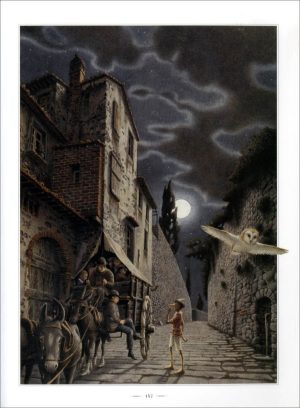
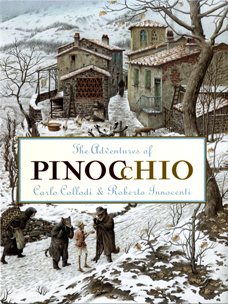
If you want to explore this classic and really understand it, the New York Review of Books provided an excellent translation by Geoffrey Brock with notes by Eco and Rebecca West. My favorite version for children remains the Creative Editions 2005 version of The Adventures of Pinocchio, with Roberto Innocenti’s dark and haunting illustrations. The master of unforgettable picture-book illustrations, Innocenti does not flinch away from the dark side of this story; he gives meaning and substance to Collodi’s sometimes disturbing text. For more information and art check out ReadAloud Dad.
What surprised me the most in rereading Pinocchio was how little time is spent on the idea of Pinocchio’s nose growing when he lies. That detail has haunted me from childhood—and probably made me a bit more truthful than I would be otherwise. But however you remember the story, you will be amazed when you actually pick it up in either of these excellent translations.
Here’s a page from Pinocchio: