Daily children’s book recommendations and events from Anita Silvey.
Discover the stories behind the children’s book classics . . .
The new books on their way to becoming classics . . .
And events from the world of children’s books—and the world at large.
Find a Book!
Search the archives for recommendations by age group, book type, subject, date, and more.


One Crazy Summer
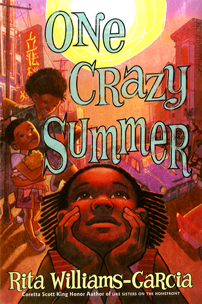
Today begins the celebration of Kwanzaa, extending through the first of January. Honoring African culture, Kwanzaa was created in 1966 to “give Blacks an alternative to the existing holidays.” Today, December 26, marks the day to strive for and maintain unity in the family, community, nation, and race. But if you wanted to explain to children the beginnings of this holiday, how would you talk about the Black national movement of this time period—one so different from today? If you are hunting for a Kwanzaa present or an appropriate title to explain the 1960s, pick up One Crazy Summer by Rita Williams-Garcia.
In One Crazy Summer, Rita has created a powerful book that explores a period in history while it pulls in young readers because of its engaging characters. In the summer of 1968, three sisters, Delphine, age eleven, Vonetta, and Fern, find themselves living for twenty-eight days with their mother, Cecile, in Oakland, California. She had abandoned all of them as children and does not seem particularly excited to see them in her living space. A poet and an activist, Cecile (called Nzila by the Black Panthers) forbids them entry to her kitchen and wants them out of the way all day.
Delphine, the oldest and the narrator of the saga, takes things in her own hands, caring for her sisters. In order to obtain breakfast, they spend their days at a summer camp sponsored by the Black Panthers, who provide food and education to those in the community. Although at first they are dismissive of what they hear at camp, the girls begin to comprehend the message of activism preached there. When Nzila and two Black Panthers get arrested, Delphine and her sisters go into high gear to honor the mother.
Delphine absolutely engages the reader; her incredible sense of responsibility for her sisters and her longing for a mother’s acceptance ring so true. In this character-driven novel, Rita Williams-Garcia brings to life the community of Oakland and the issues of the 1960s. She incorporates a lot of humor into these serious subjects. As the Brooklyn girls respond to utterly new teachings in classes, they are not beyond letting members of the Black Panthers know that they “didn’t come for the revolution. We came for breakfast.”
Because the book remains so true to an eleven-year-old point of view, and because in the end, Delphine finally gets what she had traveled all those miles to find—the acceptance of her mother—the story works as a family saga with history interwoven. So whether you read One Crazy Summer to understand the Black Panthers, or you just want to pick up a mother/daughter saga, there is a lot of wisdom to be found in these pages.
Here’s a passage from One Crazy Summer:
In the animal kingdom the mother bird brings back all she’s gathered for the day and drops it in the open mouths of each bird squawking to be fed. Cecile looked at us like it didn’t occur to her that we would be hungry and she’d have to do what mothers do: feed their young. I’m no Big Ma in the kitchen, but I would have opened a can of beans and fried up some franks. I can bake a chicken and boil potatoes. I would have never let my long-gone daughters travel nearly three thousand miles without turning on the stove.
Also recommended:
- Like Sisters on the Home Front and other titles by Rita Williams-Garcia
Additional Information
A few other events for
- Happy birthday Jean Van Leeuwen (Amanda Pig series, Cabin on Trouble Creek) and Eric Luper (Seth Baumgartner's Love Manifesto.)
- It’s the birth date of Ella Young (1867–1956) The Tangle-Coated Horse and Other Tales.
- In 1966, the first Kwanzaa is celebrated by Dr. Maulana Karenga, chair of Black Studies at California State University, Long Beach. Read The Children’s Book of Kwanzaa by Dolores Johnson, Li’l Rabbit’s Kwanzaa by Donna L. Washington, illustrated by Shane W. Evans, Seven Spools of Thread by Angela Shelf Medearis, illustrated by Daniel Minter.
- It’s National Thank-You Note Day. Sit down and write some cards to acknowledge those winter holiday gifts!
- It’s also Boxing Day. Read Not a Box by Antoinette Portis.