
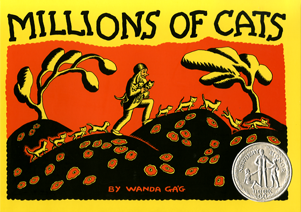
December 15 has been designated Cat Herding Day. Certainly, this impossible task deserves to be celebrated! Eighty-two years ago a classic children’s book demonstrated what a lot of herded cats might look like—although it left the way to accomplish this feat unexplained. In the history of picture books, men have created the vast majority of classics, and recently men have won the Caldecott Award for their art much more frequently than women. But our first celebrated American picture book, Millions of Cats, which won a Newbery Honor because the Caldecott had not yet been established, was created by a very talented woman.
Minnesota’s Wanda Gág had come to New York and was showing her bold prints in galleries when editor Ernestine Evans contacted her. Evans, just hired to create a children’s book department for Coward-McCann, saw an exhibit of Gág’s prints and approached her to see if she would consider creating a children’s books. Materials at the Kerlan Collection at the University of Minnesota, indicate that Gág had started a children’s book story around 1922 but had abandoned it. Encouraged by Evans, she picked it up again, focused the story, and made the refrain occur many more times:
Cats here, cats there,
Cats and kittens everywhere,
Hundreds of cats,
Thousands of cats,
Millions and billions and trillions of cats.
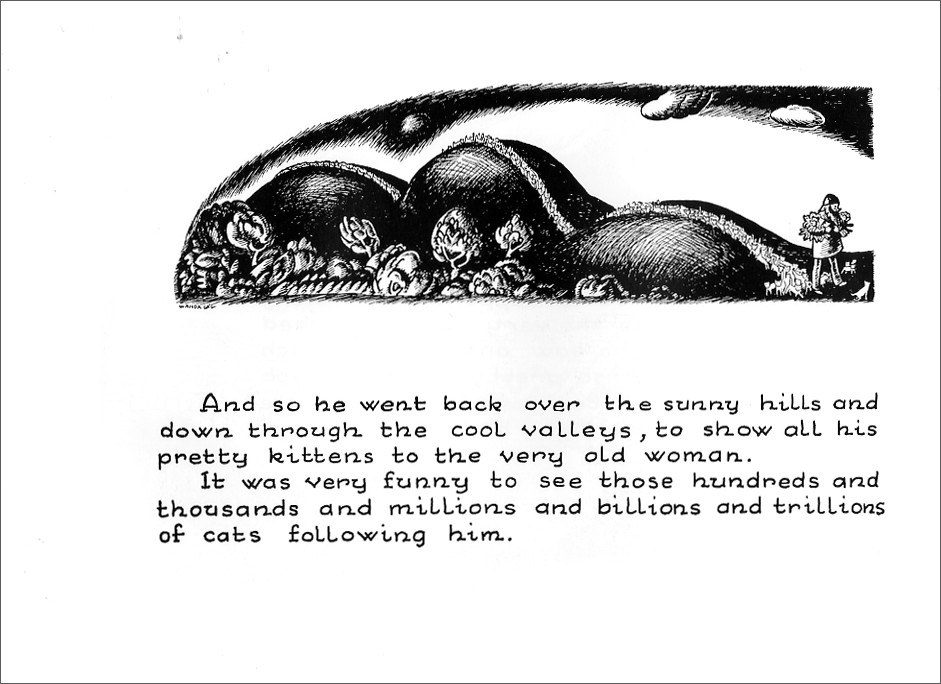
In Millions of Cats an old man goes out to find a kitten for his wife. He travels over hills and valleys and locates far too many. But after they eat each other up, only one thin scraggly kitten is left. In the end it becomes the beautiful cat the man and woman have sought. The language and feel of the story reflect Gág’s German roots; in fact, she would later translate and illustrate volumes of Grimm’s fairy tales for her adoring audience.
As classics go, Millions of Cats has one of the shortest creation times on record. Gág had only a couple of months to craft the text and art. In the end she relied on the help of others; her brother actually hand-lettered the text. In Millions of Cats Gág pushed the boundaries of the picture book. She developed double-page spreads, pulling the two pages together with an image. She wrapped text around the art. Using a varied layout and alternating broad vistas with intimate scenes, she developed pacing, timing, and tension. In one title, she basically invented the American picture book.
So today I’d like to honor our great-great-grandmother, as it were, of the American picture book. In 1928 she set in motion ideas about this form that others would take eight decades to explore. Considered one of the finest artists of her day, Gág also lent credibility to the idea that other artists might want to explore this form. Over the years others from the fine art world, people like Lynd Ward and Chris Van Allsburg, have followed the same call. And the thousands of picture books each year—that focus on page layout, pacing, and timing—all have their beginning in Millions of Cats.
Here’s a page from Millions of Cats: