

January is appropriately named National Soup Month. Inevitably, when the weather turns chilly, I gravitate toward warm soup, a fire, and a good book.
Susan Meddaugh began her career as a graphic designer in the children’s book department of Houghton Mifflin. She worked with James Marshall, Bill Peet, Bernie Waber, and David Macaulay, among others, to help design some of their classic books. But she longed to create ones of her own and in the 1980s began publishing some.
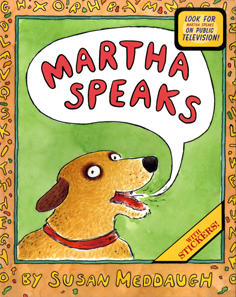
Susan came from a family of dog nuts and in turn became a dog owner herself. A stray dog adopted by the family, Martha, would become Susan’s muse. In Martha Speaks, Susan developed a fabulous premise for a book. What if, after being fed alphabet soup, a dog could actually talk? How would that affect the people in the family? After all, if dogs are unhappy, they can’t verbally list their grievances. But Martha the dog can comment on everything.
Susan sets up the book according to a child’s sense of logic—the letters from the alphabet soup go to Martha’s brain rather than her stomach; an idea suggested to Susan by her son. In the story, Martha begins talking with her family. They ask her why she drinks out of the toilet. She tells them she dreams about chasing meat loaf. Because Martha uses language the way a child does—honestly and with no sense of what might be appropriate or inappropriate—she causes both a lot of laughs and a lot of trouble: “Mom said that fruitcake you sent wasn’t fit for a dog. But I thought it was delicious.”
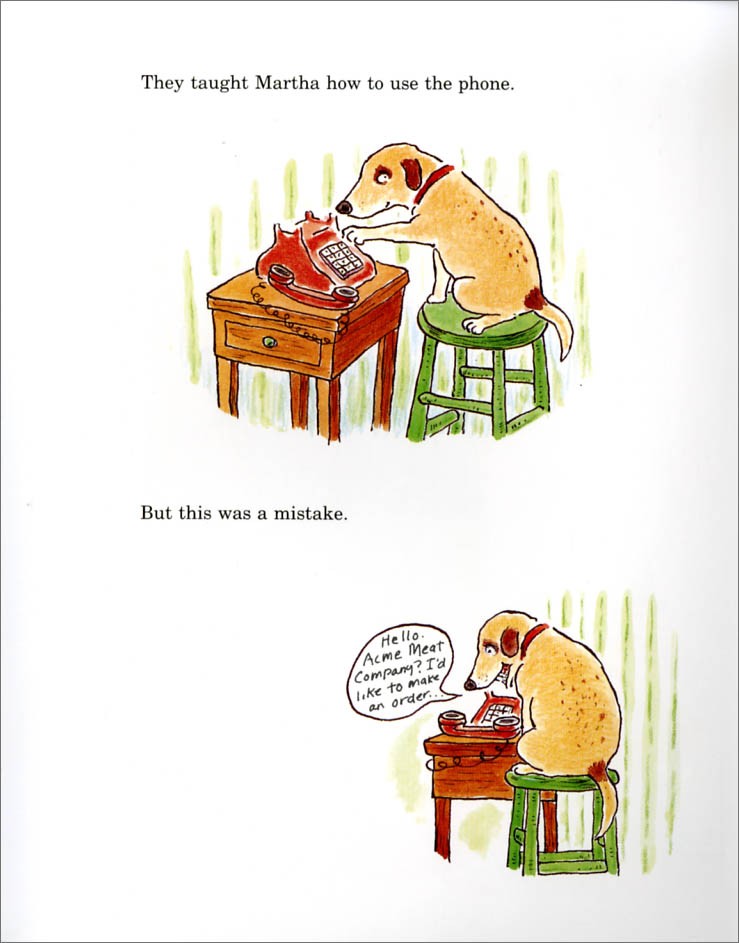
Then the family teaches her how to use the telephone—and Martha begins to think for herself. Eventually, Martha simply talks too much, and her family gets mad at her. Dejected, she stops eating alphabet soup—that is, until the moment that she needs to speak to save the house from a burglar.
Martha Speaks and its sequels, ideal for two to eight year olds, contain all of the elements of great picture books—a story arc with a great ending, illustrations that extend the humor of the text, and exquisite pacing and timing. Martha has come up in the world since her humble beginnings in 1992 and now has her own PBS television series. So if you like this dog, you can follow her adventures in many different forms.
I myself will celebrate National Soup Month by rereading Martha Speaks—it makes me even happier than soup itself.
Here’s a page from Martha Speaks: