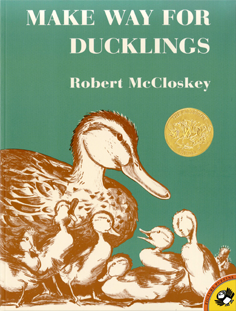
In August of 1941 a picture book appeared that has become synonymous with the city of Boston for millions of readers. While he was an art student there, Robert McCloskey got the idea for Make Way for Ducklings from a true story that appeared in the newspaper. However, he developed the book in New York while living in a small Greenwich Village apartment with illustrator Marc Simont.
Unfortunately, although he had a great story about Mr. and Mrs. Mallard and their search for a safe home for their ducklings, McCloskey didn’t know how to draw ducks. He went to the parks and the Museum of Natural History—and hundreds of duck drawings emerged from his pen. Finally, in an act of desperation, he went down to a market in Greenwich Village, bought some ducks, and brought them back to his apartment and put them in his bathtub. Then, every day, he woke up with a tissue to clean up after them in one hand and a sketchbook in the other. But the ducks still moved too quickly for McCloskey to capture them in detail.
Finally, one night as he and Simont were having dinner, a solution occurred to the frustrated artist: McCloskey gave the ducks some of the red wine he was enjoying that evening, and the ducks slowed down. This ritual became part of his creative work, and the male mallard even became addicted to the wine, driving the female ducks away so he could get it first. McCloskey later apologized for his youthful misdemeanor. If you look closely to the page where a boy goes speeding by on a bicycle, you will notice a male mallard back on his wings. I have always believed that this picture was drawn from a drunken duck.
In the final picture for Make Way for Ducklings, the reader sees Mr. Mallard waiting for his family on a safe island, one without turtles and foxes. Because the book was published during World War II, the first children who read it often had fathers away from home. It sent a subtle, but powerful message: that the family would be reunited in a safe place.
However unorthodox McCloskey’s methods, they always remind me that a great book requires an author and artist be willing to go many extra miles to complete a classic. And for seventy years, children have delighted with the adventures of Jack, Kack, Lack, Mack, Nack, Ouack, Pack, Quack, and their parents as they explore the city of Boston. So happy birthday Make Way for Ducklings. I’m headed down to Boston Gardens to pat the statues placed there in your honor.
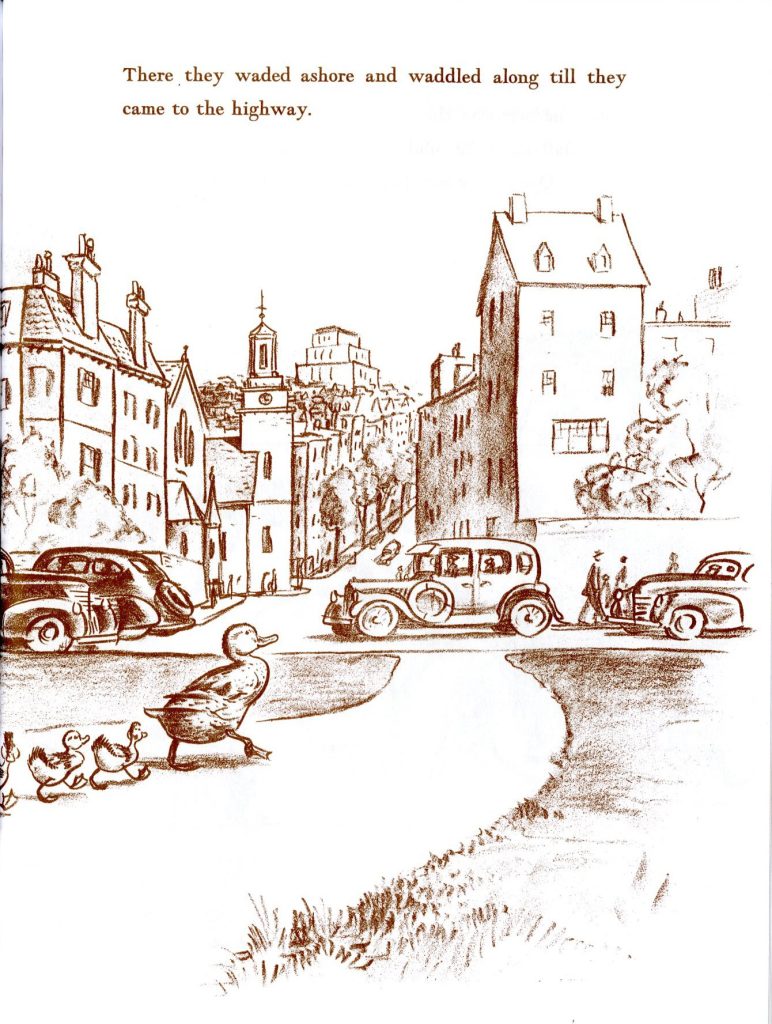
Here’s a page from Make Way for Ducklings: