Daily children’s book recommendations and events from Anita Silvey.
Discover the stories behind the children’s book classics . . .
The new books on their way to becoming classics . . .
And events from the world of children’s books—and the world at large.
Find a Book!
Search the archives for recommendations by age group, book type, subject, date, and more.
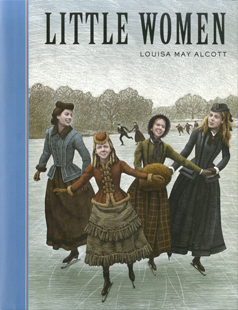
On July 15, 1868, an author who had been known for worthy adult writing—a novel called Moods and a Civil War memoir Hospital Sketches—finished the first half of a book that would secure her literary immortality. This was not an adult book but a girls’ story. Louisa May Alcott had actually bristled when her editor suggested she write such a manuscript; she had no interest in creating books for girls at all. In her diary she mentions that besides her three sisters she knew very little, if anything, about young women. In the end, however, every person has the authority to write for children because each of us has once been a child.
Always in desperate need of money to support her family, Alcott decided that she and her three sisters might, indeed, provide some intriguing subject matter for a children’s book. Beginning in May of 1868, she turned out the first half of Little Women in a mere ten weeks. In it she related the story of the four March girls—determined Jo, beautiful Meg, saintly Beth, and artistic Amy—who struggle with the Civil War, its aftermath, and their poverty. With a modest printing of two thousand copies, the first half of Little Women, which appeared in the fall of that year, became an immediate sensation. Alcott finished the rest of the manuscript a few months later, and it was published in March of 1869. The book we know today contains both volumes.
By the time she wrote the rest of the book, Alcott had already heard from enough of her readers to know they universally wanted—much as they often do today—Jo March to marry the wealthy Laurie, her best friend who loves her. But Alcott, who always claimed that she wanted to paddle her own canoe, had no patience for pat solutions for her beloved female character. Jo would take another, more unconventional, path.
Because of this artistic decision, Jo March may have inspired more women over the years—including Hilary Clinton and French philosopher Simone de Beauvior—than any other character in a children’s book. As actress Julianne Moore says in Everything I Need to Know I Learned from a Children’s Book, “From Jo I learned that a woman could choose…that she has a choice about her career.”
Thank you, Louisa May Alcott for deciding to write that girls’ story. It is the longest in print American classic for children and has encouraged readers to think outside the box for over 140 years.
Here’s a passage from Little Women:
“What in the world are you going to do now, Jo?” asked Meg, one snowy afternoon as her sister came tramping down the hall, in rubber boots, old sack and hood, with a broom in one hand and a shovel in the other.
“Going out for exercise,” answered Jo, with a mischievous twinkle in her eyes.
“I should think two long walks this morning would have been enough! It’s cold and dull out; and I advise you to stay warm and dry, by the fire, as I do,” said Meg, with a shiver.
“Never take advice! Can’t keep still all day, and, not being a pussy-cat, I don’t like to doze by the fire. I like adventures, and I’m going to find some.”
Also recommended:
- Little Men and the rest of the series by Louisa May Alcott
Additional Information
A few other events for
- It’s the birth date of Clement C. Moore (1779-1863) The Night Before Christmas, and Walter Edmonds (1903-1998), Drums Along the Mohawk.
- The artist Rembrandt (1606-1669) was also born on this day. Read What Makes a Rembrandt a Rembrandt? by Richard Mühlberger.
- In 1922, the first duck-billed platypus is publicly exhibited in the United States, at the New York Zoo. Read Platypus by Chris Riddell, Platypus! By Ginjer L. Clarke, illustrated by Paul Mirocha, and A Platypus, Probably by Sneed B. Collard III, illustrated by Andrew Plant.
- It’s National Rabbit Week (July 15–21). Read Rabbit Hill by Robert Lawson; Mr. Rabbit and the Lovely Present by Charlotte Zolotow, illustrated by Maurice Sendak; Runaway Bunny by Margaret Wise Brown, illustrated by Clement Hurd; and the Max and Ruby series by Rosemary Wells.
- It’s I Love Horses Day. Read The Black Stallion by Walter Farley and National Velvet by Enid Bagnold.
- It’s Cow Appreciation Day. Read Cow by Jules Older, illustrated by Lyn Severance; Click, Clack, Moo: Cows that Type by Doreen Cronin, illustrated by Betsy Lewin; Amazing Cows: Udder Absurdity for Children by Sandra Boynton; and Meow Said the Cow by Emma Dodd.