
Born in Denmark on September 13, 1920, Else Holmelund Minarik came to the United States when she was four. At first she hated English, the new language that she had to learn, but she became devoted to it—and to teaching first graders how to read words that had once perplexed her.
As she observed her students, Minarik realized that at the point when they had mastered basic reading skills, they wanted a book a bit more sophisticated than a picture book. But most novels fell outside their range. She worked on a prototype for such a book and brought it to Susan Carr Hirschman, then Ursula Nordstrom’s assistant at Harper. Minarik believed that her manuscript, some stories about a character called Little Bear and his mother, was perfect for students at the end of first grade or beginning of second.
Hirschman took the manuscript “What Will Little Bear Wear” immediately to Nordstrom. For some time Nordstrom had been trying to interest some of the Harper authors on the same kind of idea—and they all had turned it down. Now here was real teacher, with experience, who could help frame the books. Although Minarik’s role was not acknowledged at the time, she, in fact, became the consultant for the entire Harper I Can Read series, as these books were called. She helped establish character counts for each line (no more than forty), the spacing between the lines of text, and made sure the subjects of the books remained appropriate for first and second grade students.
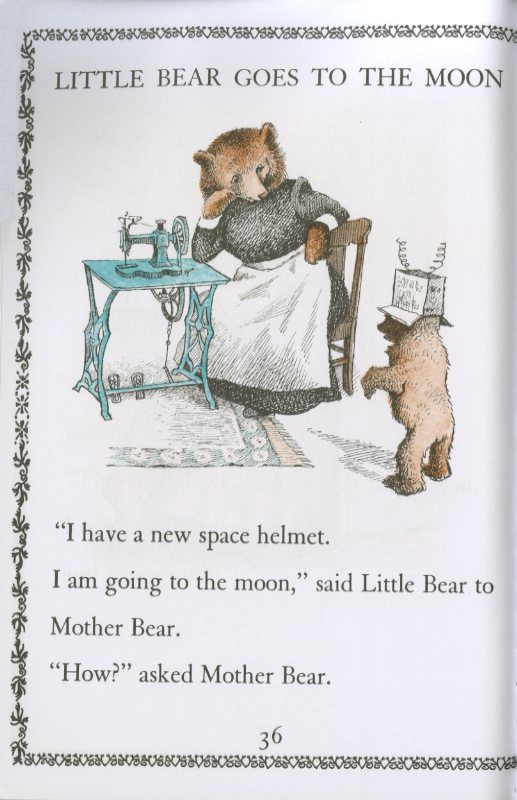
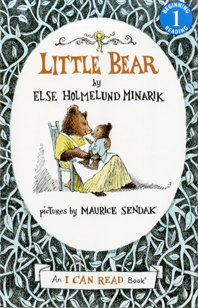
For the truly lovable character that Minarik created, Nordstrom had no trouble choosing her favorite illustrator, Maurice Sendak. Sendak’s Little Bear has heft and weight as he interacts with his mother in a warm, respectful, and playful way. In one story Little Bear pretends to fly to the moon, and his mother plays along. However, when he tires of the game he says, “You are my Mother Bear/and I am your Little Bear/and we are on Earth, and you know it.” The four stories in the first Little Bear book, which would be followed by others, attest to the universal need for love, acceptance, and independence.
With more than six million copies in print, the Little Bear books have beguiled children since 1957, convincing them that they really enjoy this new skill called reading. We can all be grateful that Else Minarik took what she learned in a classroom and made it possible for millions of children to enjoy books.
Here’s a page from Little Bear: