
Today is June 29 and even saying that phrase makes me think of our most awarded children’s book illustrator, three-time winner of the Caldecott Medal, David Wiesner. David began his work at Rhode Island School of Design, a student of David Macaulay. Even as a boy, David knew that he wanted to be an artist, and his family supported his dream. As a student at RISD, he was searching for a way to create a different kind of picture book for children—one that would rely much more on the pictures than the words. He wanted to see how few words he could use in a book.
To establish himself as an illustrator, he took whatever work came his way. Trina Schart Hyman, art director of Cricket Magazine, ask him to illustrate the cover of an issue with frogs; others gave him covers or interior art assignments. Like so many truly talented people, David did not really fashion his best books until an editor, in his case Dorothy Briley of Clarion, had enough faith in him to allow him to take over the whole book—text and art. His first solo attempt, Freefall, a Caldecott Honor, used no words at all. In the dream sequences of the book, characters walk, float, fly, and ride through metamorphosing landscapes. By following illustration clues, young viewers can create their own story by viewing the pictures.
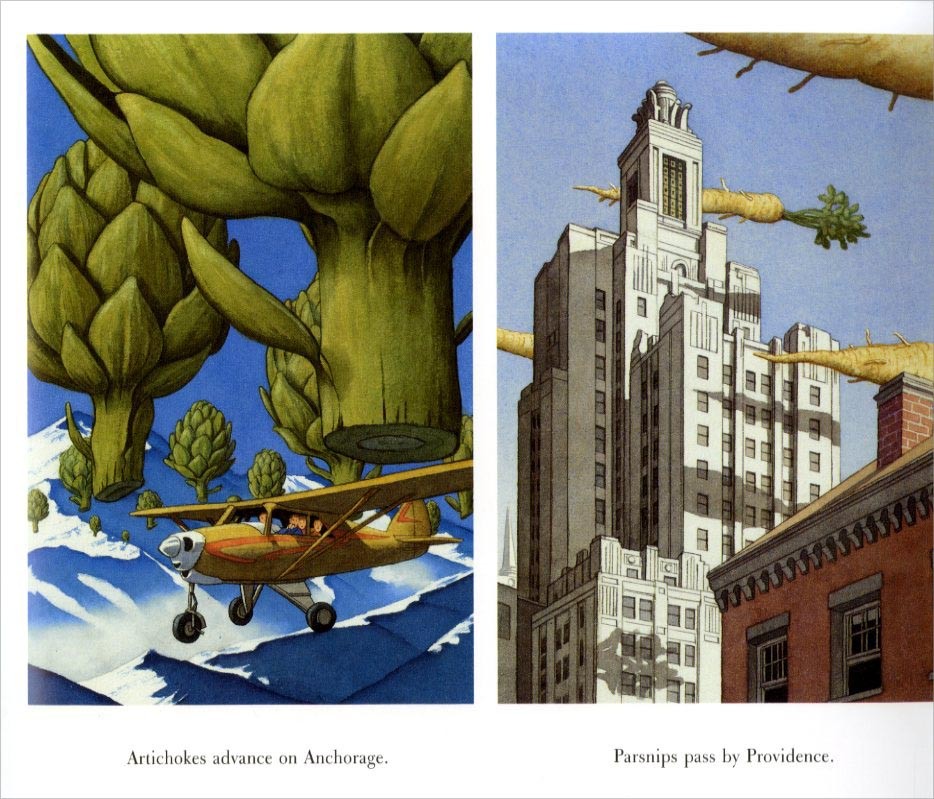
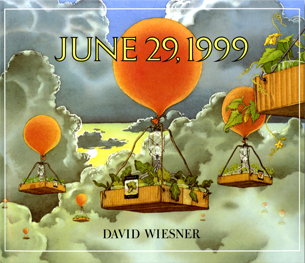
In 1992, he published June 29, 1999—an interesting exploration of a school science project. Holly Evans has been sending seeds into the ionosphere to test the effects of extraterrestrial conditions on vegetables. Suddenly the skies fill up with gigantic vegetables. “Cucumbers circle Kalamazoo./ Lima beans loom over Levittown./ Artichokes advance in Anchorage./ Parsnips pass by Providence.” But some of these species have not been initially launched by Holly. So what is going on? On the final pages, David brings science and extraterrestrials together in a completely unexpected way.
Right around this time of year, I ask my summer school class at St. Michael’s College in Vermont to examine all of David Wiesner’s books. He makes the perfect candidate for an author study because from his student years to his three Caldecott Medal books—Tuesday, The Three Pigs, and Flotsam—to his latest triumph, Art & Max, he has created one brilliant picture book after another. But sometimes even fans of Wiesner have missed June 29, 1999. If you have, too, once you discover it you may find yourself looking up at the sky from time to time, attempting to see if any giant cauliflowers are floating near you.
Here’s a page from June 29, 1999: