
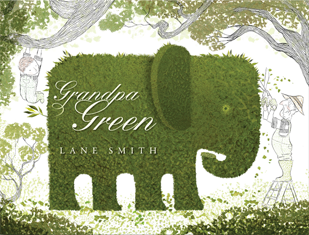
Since 1978 the first Sunday after Labor Day has been celebrated as National Grandparents Day to encourage grandchildren to tap into the wisdom and heritage of their grandparents. Encapsulating both the spirit and the intent of this holiday, our book-of-the-day is Grandpa Green by Lane Smith.
As editor of The Horn Book Magazine I watched the beginning of Lane Smith’s career. First he contributed art to some highly original works, such as Eve Merriam’s Halloween ABC. And then, of course, he made his mark by teaming up with Jon Scieszka on original books like The True Story of the Three Little Pigs, The Stinky Cheese Man and Other Fairly Stupid Tales, and Baloney (Henry P.). What I loved about Lane as an artist then remains what I love about him now: he takes risks; he never does the same book twice; he clearly sides with young readers rather than adult critics like me. Whether playing around with the ISBN notice on the back of Stinky Cheese Man or challenging readers to think about computers in It’s a Book, Lane Smith creates very sophisticated art that makes children laugh and makes them want to return to books again and again.
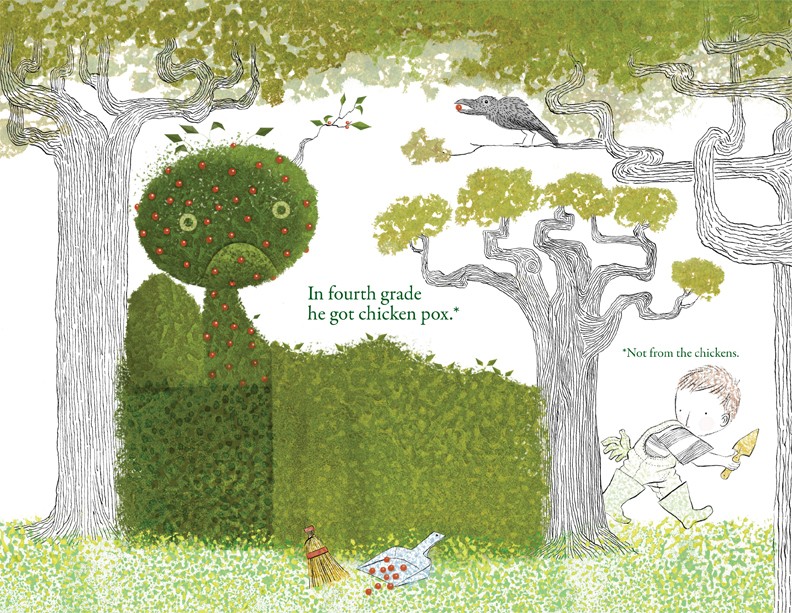
Grandpa Green draws from a different side of Lane Smith. Although touches of humor can be found in all the art, this book pulls at the heartstrings. From the opening illustration of a topiary trimmed like a crying baby, “He was born a really long time ago/before computers or cell phones or television,” to the final picture of Grandpa Green being depicted in a topiary by his grandson, every detail of this book is fresh and original. As Lane Smith traces the life story of Grandpa Green, the art, using a muted palette of brown and green, displays magnificent topiary creations that blend in with the ideas explored in the text. Readers watch Grandpa Green grow up on a farm, get chicken pox, and entertain himself while sick. Certainly one of the best spreads shows The Wizard of Oz characters presented as topiary constructions. Grandpa Green fights in a war, meets his wife, and settles down to a life of horticulture. About halfway through the book, the identity of the narrator is revealed: he is Grandpa Green’s great-grandchild. And although Grandpa Green has grown old and forgetful, the garden helps him remember important things. This book is as subtle as The Stinky Cheese Man was bold and brash.
Thank you Lane Smith for all your books. And thank you for taking risks and doing something different decades into your career.