
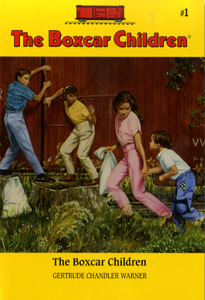
Today we honor a writer who has inspired millions of children over the years to fantasize about living in a broken-down railroad boxcar. Born on April 16, 1890, in Putnam, Connecticut, Gertrude Chandler Warner lived across the street from the railroad station. Thirty freight trains might have passed by every day. Young Warner would talk to the men on the train and peek inside to see the neatly arranged living quarters. And she asked herself what it would be like to live in a caboose or a boxcar.
Due to poor health, Warner spent most of her schooling with a tutor and discovered that she loved to write. During World War I, although she did not have a high school diploma, she was recruited to teach—something that she continued for thirty-two years. While in the classroom, she began to work on a story inspired by her childhood fantasy. Putnam, a mill town, drew a diverse population, and many of her students struggled to learn English as a second language. She developed her tale to help these immigrant children and other slower readers. But she also worked to provide a fascinating story, one that would appeal to the better students in her class. The resulting book, The Boxcar Children, uses simple words and concepts, appeals to a wide range of readers in first and second grades, and contains a very compelling plot line.
In this totally satisfying book, the four Alden children—Henry, Jessie, Violet, and Benny—have become orphans and run away rather than be taken to their grandfather, who they do not know but fear. With only a few dollars in Henry’s pocket, the children locate an abandoned railroad boxcar and furnish it with pine branches and plates and cups from a nearby dump. Henry locates work that provides food and money, and they transform their surroundings into a kind a paradise, complete with a swimming hole for hot summer days. A spot behind a waterfall serves to keep butter and milk cold. In short, every small object the resourceful children find is made useful. In the end, their grandfather turns out to be kindly and takes them in, but he transfers the boxcar to his property so they can have more adventures.
Scott, Foresman & Company, a textbook publisher that sold books to schools, released Warner’s second version of the story in 1942. The silhouettes that adorn the book were no doubt inspired by Warner, who loved to give a silhouette portrait to each of her students. Albert Whitman & Company took over publication in the mid 1950s and made a paperback issue available in 1989. This led the way for a whole new generation of readers to fall in love with the Alden children—now more than 120 books exist in the series, graphic novels have been based on the books, and Patricia MacLachlan is currently writing a prequel to Warner’s original book.
Naturally, a few grown-ups protested about children living unsupervised. But this detail has never bothered children. In fact, it taps into a frequent childhood fear—what if children had to live without adults? Once a child reads The Boxcar Children, he or she never has to worry again. Readers love the self-reliance of this family and the way they work together for a happy ending.
If you are ever near Putnam, Connecticut, stop by and visit the Gertrude Warner Museum right near the railroad station. They won’t let you move into the boxcar —but you can see her home and the environment that inspired her books. Happy 121st birthday Mrs. Warner—you are still teaching children after all these years.
Here’s a passage from The Boxcar Children:
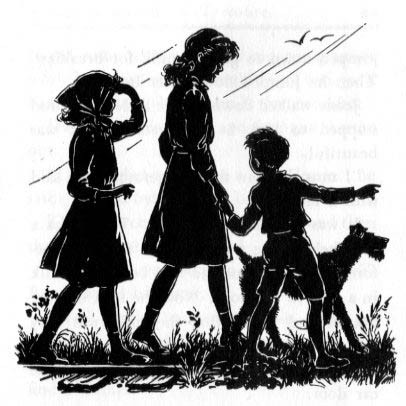
They all walked along through the woods, looking this way and that. After awhile the old track came out into the sun, and the explorers found that they were on top of a hill. They could look down and see the town below them.
“Henry is down there,” said Jessie.
Benny was walking along behind his two sisters.
Suddenly he cried happily, “Look, Jessie! There’s a treasure—a wheel!”
The girls looked where he was pointing, and they saw a big dump with many old bottles and tin cans on it. There were also both wheels and cups. Indeed, there were dishes of all kinds.
“Oh, Benny!” cried Jessie. “You saw the treasures first. What should we do without you!”