



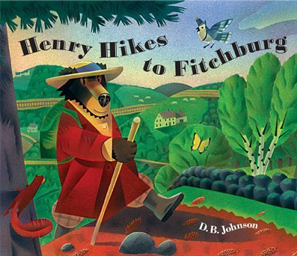
On July 12, 1817, Henry David Thoreau, American author, poet, naturalist, historian, and philosopher, was born in Concord, Massachusetts. Neighbor to other radical thinkers of his day, Ralph Waldo Emerson, Bronson Alcott—the father of Louisa May—and Nathaniel Hawthorne, Thoreau believed in living simply. He built a small cabin near Walden Pond, where he stayed alone, and then described his experience in his most famous work Walden. In this book, Thoreau argues that rather than riding thirty miles on a train, and having to earn the money to do so, a person would be better walking that distance. “I have learned that the swiftest traveler is he that goes afoot.” This concept, developed by artist and storyteller D. B. Johnson, forms the basis of Henry Hikes to Fitchburg.
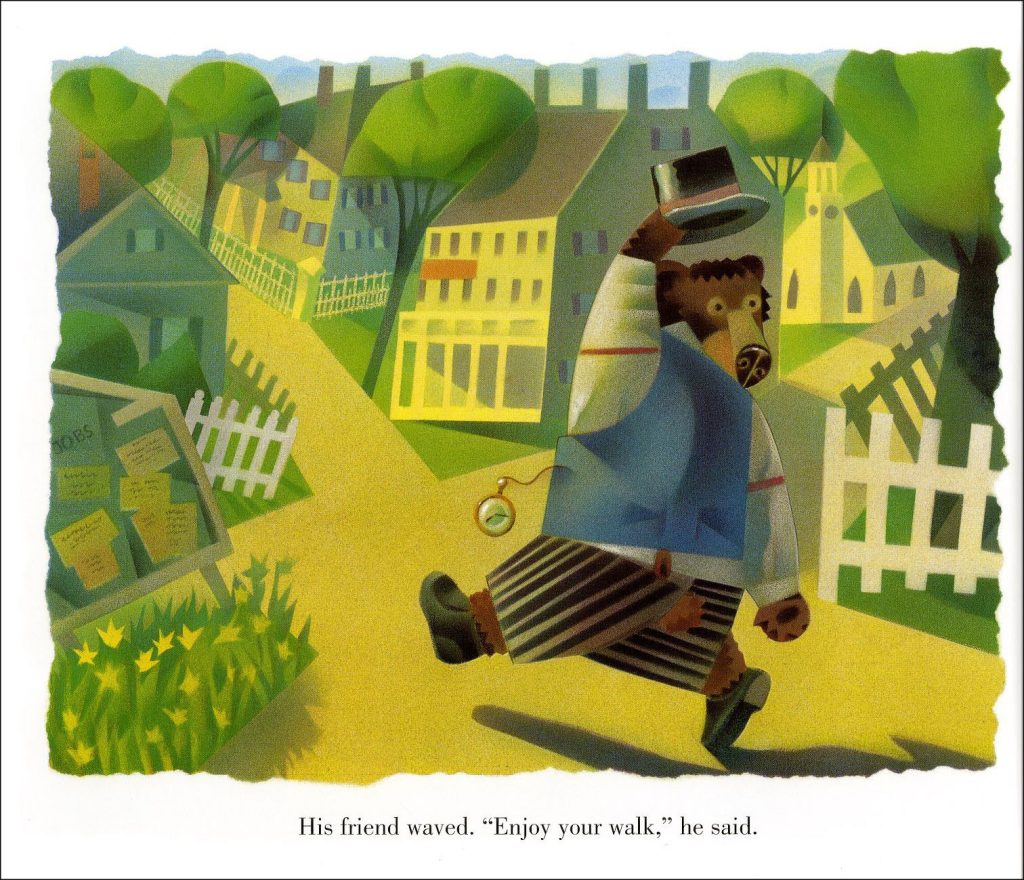
Johnson tried for almost a decade to get one of his picture books published. Finally, when he turned to his idol Henry David Thoreau for inspiration, he found the story that he needed. In this absolutely charming saga, Henry, depicted as a bear, and a friend make a wager: Henry will walk; his friend will work and then take the train. Who will get to Fitchburg, a community thirty miles outside of Boston, first? On one side of each double-page spread, readers see Henry’s friend complete a task, on the other watch Henry enjoy the countryside as he travels. Henry’s friend works at the Alcott, Hawthorne, and Emerson homes. Henry carves a walking stick, presses ferns and flowers, rafts down the river, swims, and stops to eat blackberries. Although his friend arrives before him, and insists the train was faster, Henry simply replies—“I know. I stopped for blackberries.”
Perfect for four- through eight-year-olds, the book introduces the world of the transcendentalists to the very young, but also, like its subject Henry David Thoreau, raises questions about the best way to spend one’s day and live one’s life. Cubist-inspired paintings filled with detail bring Henry’s world vividly to life. In Henry Hikes to Fitchburg, one of the best debut books of the last decade, Johnson both educates and delights—something Henry David Thoreau himself would approve of.
Here’s a page from Henry Hikes to Fitchburg: