The Book Thief
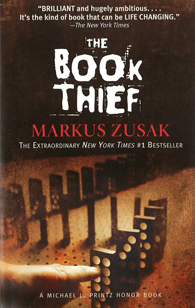
May serves as both Personal History Awareness Month and Jewish American Heritage Month. When I saw these events, I immediately thought of one of the most amazing novels of the last ten years, Marcus Zusak’s The Book Thief. Although Zusak grew up in Australia, his mother had lived in Munich during the reign of Hitler and the Nazis. While he was a child, she shared stories of what had happened during those years: the bombings and the treatment of Jewish citizens. For his great novel, Zusak returned to these stories that had fascinated him as a child.
On the bestseller list in the United States since in appeared in 2006, The Book Thief has been used in classrooms from fifth grade through high school. It answers the question: What should young readers pick up after The Diary of Anne Frank?
Using the audacious narrative voice of death himself (third-person, omniscient in the extreme), Zusak introduces readers first to the character of nine-year-old Liesel Meminger who is being delivered, along with her brother who dies, to the Hubermans of Himmel Street in Molching. A modern Anne of Green Gables, Liesel becomes the foster child of the Hubermans. They shelter her in Nazi Germany even though they are poor and she comes from a Communist family. On her way to them, Liesel steals the first of many books, The Grave Digger’s Handbook. She can neither read nor write, but her foster father, Hans, teaches her how to do both from this slim volume.
A master at foreshadowing, Zusak slowly builds the horror of life in Nazi Germany. Hans, who doesn’t fancy the party, applies for membership but never gains entry. Liesel’s foster mother showers her with swear words, but still cares for this frail girl. Liesel slowly adapts to her new surroundings, makes a best friend in Rudy Steiner, and then protects the family secret when another child arrives to be sheltered—a Jewish boy named Max.
Zusak is a master at creating place and character. So believably do the events play out that readers get swept up in the history and become emotionally attached to both Liesel and Max. But Zusak never sugarcoats the events or the horror of living in Nazi Germany during the Second World War.
Many young readers have found that this book has changed their perception of the world. If you have missed this singular novel, you need to pick it up immediately. I found it even more brilliant on a second reading.
Here’s a section from The Book Thief:
The last time I saw her was red. The sky was like soup, boiling and stirring. In some places, it was burned. There were black crumbs, and pepper, streaked across the redness.
Earlier, kids had been playing hopscotch there, on the street that looked like oil-stained pages. When I arrived, I could still hear the echoes. The feet tapping the road. The children-voices laughing, and the miles like salt, but decaying fast.
Then bombs.
This time, everything was too late.
The sirens. The cuckoo shrieks in the radio. All too late.
Additional Information
A few other events for
- Happy birthday M. E. Kerr (Deliver Us From Evie) and Lynn Sweat (Amelia Bedelia series).
- It’s the birth date of Rachel Carson (1907-1942), author of Silent Spring, credited for starting the U.S. environmental movement. Read Rachel Carson: Clearing the Way for Environmental Protection by Mike Venezia, and Rachel: The Story of Rachel Carson by Amy Ehrlich, illustrated by Wendell Minor.
- In 1933, Walt Disney released the cartoon Three Little Pigs, with the song “Who’s Afraid of the Big Bad Wolf?” Read The Three Pigs by David Wiesner; The Three Little Wolves and the Big Bad Pig by Eugene Trivizas, illustrated by Helen Oxenbury; and the Little Golden Books Disney edition of Three Little Pigs.