


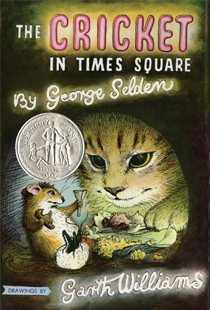
More than fifty years ago a down-on-his-luck, New York City playwright who had graduated from Yale wandered into the Times Square subway station late at night and heard a cricket chirp. It reminded him of his childhood in Connecticut when his life had been more optimistic and innocent. Because he knew how to write scenes and create characters as a playwright, he began crafting a book about a little cricket from the country in a big city subway station and the boy who finds him there. The book’s proceeds would lift George Selden out of poverty and despair.
The Cricket in Times Square turns fifty-one this month, although it still seems young to me. To write this funny and intriguing story, Selden drew on what he knew—a love of music, particularly opera, and the longing of city dwellers for the simple country life. Children and adults find themselves falling in love with Selden’s characters—both human and animal. They include Chester, a cricket who adores liverwurst; Mario Bellini and his parents, running an unsuccessful newspaper stand in the Times Square subway; Tucker, an amiable scavenger mouse; and Harry, the warm-hearted cat. Chester arrives in the Times Square subway station from his home in Connecticut via a picnic basket. After Chester befriends Mario, the singing insect uses his operatic talents to bring customers to the newsstand. But in the end, Chester leaves fame, fortune, and the city behind so that he can return to his country home.
Like Charlotte’s Web, the book explores enduring friendships and community between unlikely protagonists. The two books, in fact, often appeal to the same readers. Both were illustrated by Garth Williams, who uses humor to delineate characters through his artwork. Although Williams and Selden were paired by their publisher, they went on to develop a friendship of their own and worked together on sequels such as Tucker’s Countryside and Chester Cricket’s New Home.
We have every reason to be grateful that George Selden took the advice given to him by Noel Coward at a party: “Press on!” Selden did, and today we can celebrate over fifty years of a comic masterpiece for children because he persevered.
Here’s a passage from The Cricket in Times Square:
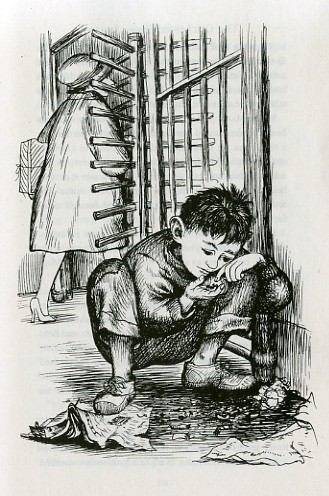
It was a little insect, about an inch long and covered with dirt. It had six legs, two long antennae on its head and what seemed to be a pair of wings folded on its back. Holding his discovery as carefully as his fingers could, Mario lifted the insect up and rested him in the palm of his hand.
“A cricket!” he exclaimed.