
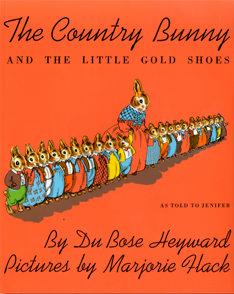
The celebration of Easter contains both religious and secular components. Today many children will search for Easter eggs, candy baskets, and the various treats that have become associated with the holiday. Although hundreds of books have been published for Easter, for me the best was published seventy-two years ago: DuBose Heyward’s The Country Bunny and the Little Gold Shoes. Although much has changed in our society, this timeless book still works beautifully for young readers.
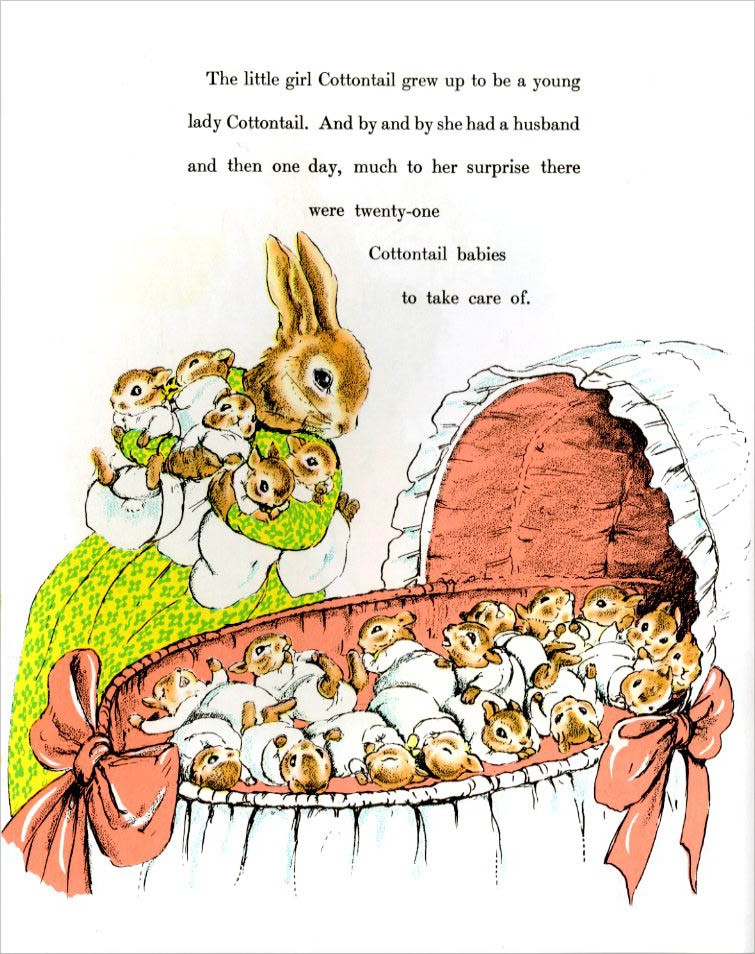
“We hear of the Easter Bunny who comes each Easter before sunrise to bring eggs for boys and girls, and we think there is only one,” begins master storyteller Heyward. Not so, he tells readers. There are five Easter Bunnies and each must cover vast territories. They must be the kindest, swiftest, and wisest bunnies in the whole wide world. One day a country bunny with brown fur dreams of becoming one of these fine Easter bunnies. But when she grows up, she has no less than twenty-one babies, and she temporarily stops thinking about hopping all over the world as an Easter Bunny. Instead she raises her babies, trains them to be productive, and keeps everything in order.
Lo and behold, one fine day the old, wise, and kind Grandfather Rabbit needs to replace one of the Easter Bunnies and ends up choosing our heroine—because he is so impressed by how well turned out all her children have become. In the second part of the story, the little country bunny gets tested on Easter day—and finally delivers the most beautiful Easter egg of all.
Heyward authored the novel Porgy, on which George Gershwin based his opera Porgy and Bess. He first told a version of this rabbit story to his eight-year-old daughter Jennifer. A frequent visitor to the McDowell Writing Colony in Peterborough, New Hampshire, Heyward narrated the story there in the summer of 1938, and illustrator Marjorie Flack, also a frequent visitor to McDowell, asked him to write it down so that she could illustrate it. It only took Heyward two hours to do so. Heyward’s proper Boston editor insisted the country bunny have a husband—although he does not make any appearance in the book. For all intents and purposes, the country bunny remains a single mother. Most often remembered for her art in The Story About Ping, Marjorie Flack drew her inspiration for this book from Japanese prints. She shifts between wonderful domestic scenes, with the bunnies engaged in activities, to broad panoramas of the Country Bunny delivering eggs. If you’re interested in the fascinating publishing history of The Country Bunny, you can find even more information here.
The story stresses the importance of hope, determination, and courage. Not only was the book a feminist statement in a time when this perspective was rarely shown, it also celebrates the achievements of a brown bunny rather than a white one. Yet at no point does the reader ever feel as if they are being given a polemic—Heyward has created a totally satisfying world.
I’m just glad that seventy-two years later, this little country girl continues to be the Energizer Bunny who keeps moving. Some books, like old wine, just get better over time; such is the case with The Country Bunny and the Little Gold Shoes.
Here’s a page from The Country Bunny and the Little Gold Shoes: