

Today has been designated Rosa Parks Day, marking her arrest on December 1, 1955, for refusing to give up her seat on a bus. The incident sparked the yearlong Montgomery, Alabama Bus Boycott and is considered the beginning of the Modern Civil Rights Movement. But today, because of the research of author Phillip Hoose, we can honor along with Rosa Parks another individual who changed history in Montgomery, Alabama.
A native of Birmingham, Alabama, Claudette Austin was named after the popular movie star Claudette Colbert. A rebellious teenager, she possessed a bit more courage than her peers. On March 2, 1955, in her high school in Montgomery, Alabama, she had been studying the Constitution of the United States. Going home that day, this young black woman did the unthinkable. When the bus driver yelled for her to yield her seat to a white woman, she refused to get up. “I was thinking. Why should I have to get up just because a driver tells me to, or just because I’m black? Right then, I decided I wasn’t gonna take it anymore. I hadn’t planned it out, but my decision was built on a lifetime of nasty experiences.” Of course, in the South at this time, she was expected, even required, to defer to whites.
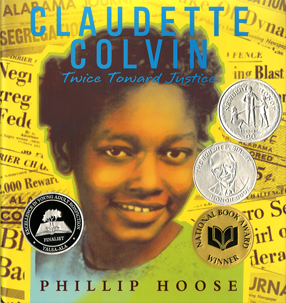
Even when confronted by policemen, Claudette shouted, “It’s my Constitutional right to sit here as much as that lady. I paid my fare!” In Claudette Colvin: Twice Toward Justice, winner of the National Book Award, author Phillip Hoose presents the life story of this unsung heroine of the Civil Rights Movement. In his fascinating account, told mainly in Claudette’s own words, readers get to see the events of 1955 in Montgomery, Alabama, from a different perspective—as they were experienced by a young girl. The book allows readers who have never known segregation to understand how it felt to be young and black in 1955. And when Rosa Parks was arrested on December 2, 1955, readers fully comprehend why the leaflet passed around that day read: “Another Negro woman has been arrested and thrown in jail because she refused to get up out of her seat on the bus.”
Since his book, We Were There, Too! Young People in U.S. History, Phillip Hoose has been exploring how teenagers can make a difference in the world. In Claudette Colvin, he brings to life one very special young woman, who truly made a difference in the Civil Rights Movement. Today we remember the contributions of Rosa Park and Claudette Colvin, both reminding us that individuals have the power to change history.
Here’s a passage from Claudette Colvin: Twice Toward Justice:
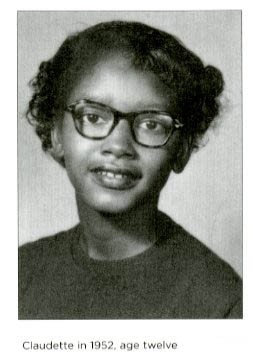
The news that a schoolgirl had been arrested for refusing to surrender her bus seat to a white passenger flashed through Montgomery’s black community and traveled far beyond. One man from Sacramento, California, wrote to Claudette:
The wonderful thing which you have just done makes me feel like a craven coward. How encouraging it would be if more adults had your courage, self-respect and integrity.
In Montgomery, students stopped one another at bus corners and by their lockers, saying things like “Have you ever heard of Claudette Colvin?” “Well, do you know anyone who knows her?” “Where’s she go to school?”