

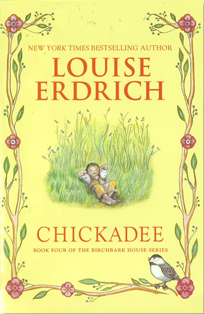
November has been designated Native American Heritage Month. A perfect book for this month is Louise Erdrich’s fabulous new novel for young readers ages eight through twelve, Chickadee.
Several years ago, Erdrich, a member of the Turtle Mountain Band of the Chippewa, began a series of books set in the same region as Laura Ingalls Wilder’s Little House books. In The Little House in the Big Woods, Wilder describes Wisconsin in the 1870s by writing, “There were no people.” Decades later Erdrich set out to inform young readers about very real and admirable people who lived in the area.
Chickadee, the fourth book Erdrich’s series, works extremely well as a stand-alone volume. Readers need not have picked up any of the other books to enjoy it, although they very well may be inspired to go back to The Birchbark House, the beginning of the series, if they haven’t read it already. Chickadee and his twin brother Makoons have always done everything together. Chickadee would prefer to have been named after a more fearsome creature than a bird, but his great-grandmother, Nokomis, assures him that “small things have great power.” One night the two high-spirited boys play a trick on one of their neighbors who had tried to trip Nokomis. But the prank does not sit well with the two victims of the prank, Babishe and Batiste, who plan some revenge of their own.
In the middle of the night they kidnap Chickadee and take him some distance to where they live. There they have him wait on them and act as a servant. Chickadee proves to be nobody’s fool; he soon outsmarts the brothers but is then taken to a Catholic missionary outpost. Once again, he escapes. In the meantime, his family sets out to find him and reunite the twins, who both suffer because they miss each other. This saga, which explains a great deal about the communities and trading patterns around the St. Paul, Minnesota area in 1866, reads like a survival story. Chickadee proves that, indeed, small things have great power; he uses his understanding of the woods to stay alive. And in this slim volume of under two hundred pages, he keeps readers turning the pages to find out if he and his family will be reunited.
In Chickadee, Louise Erdrich makes readers care about these boys and their family. It is a perfect novel to pick up for Native American Heritage Month or any other time of the year when readers need a good story, well told.
Here’s a page from Chickadee :
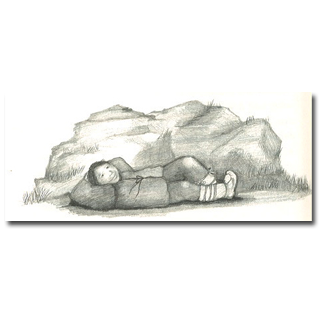 But for a moment, Chickadee was hidden from the old man’s eyes, and everybody else’s eyes, behind a small hillock of stone. And there he continued watching his namesake. The chickadee had begun its spring song, which was a sweet and lilting song, not the mischievous scolding of winter. Every spring when this happened, Chickadee felt a wash of happiness come over him. It was a promise of warmth, food, berries, summer, swimming, and fun.