Daily children’s book recommendations and events from Anita Silvey.
Discover the stories behind the children’s book classics . . .
The new books on their way to becoming classics . . .
And events from the world of children’s books—and the world at large.
Find a Book!
Search the archives for recommendations by age group, book type, subject, date, and more.

Today is the birthday of Charles Darwin. He has the distinction of being not only one of the most controversial figures of his era but also someone who still causes discord two hundred years later. Or more accurately, his theories have been controversial—often obscuring Darwin the human being. Around Darwin’s 200th birthday some excellent books began to appear for children and middle school readers, such as Peter Sis’s Tree of Life and Alice B. McGenty’s Darwin.
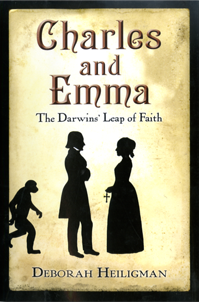
But certainly the most original book about Darwin for young readers appeared in 2009: Deborah Heiligman’s Charles and Emma: The Darwins’ Leap of Faith. Even the cover—a silhouette of a woman holding a cross, looking at a man with a simian form lurking behind him—sets the stage for the contents. In this book, which works for thoughtful readers ages eleven to eighteen, Heiligman focuses on something unexplored in most Darwin biographies: Darwin as a man and what his personal life was like during the period when he set forth his controversial ideas.
The book begins brilliantly—Darwin is conducting a scientific study, “To Marry or Nor Marry,” and listing the pros and cons of the idea. At the end of this exercise, he decides that “To Marry” seems the best idea. Charles’s choice of wife, his cousin Emma Wedgewood, will be one of his best decisions. Although they do not know each other well until they get engaged, Emma provides just the right balance for Charles. A caretaker and intelligent first critic of his work, she supports him in every way—and raises their large family while Charles works on scientific theory. At the beginning of the courtship, however, Emma has one nagging concern: she is a devout Christian and she fears for Charles’s soul because of his religious doubts.
Heiligman walks readers through the publication of On the Origin of the Species, and the furor created by the book. But the focus of Charles and Emma remains an internal drama—a portrait of the marriage and family of Charles Darwin. Hence, readers see Charles Darwin much as Emma might have viewed him, a loving husband and father, a caring human being who truly did not want to upset his wife because of his scientific writings.
Heiligman herself majored in religious studies; her husband is a science writer. Hence she understands on a personal level the issues she explores in this book. To get a better sense of Emma, Heiligman read her letters and makes Emma just as much a part of the saga as her more famous husband.
Charles and Emma can be enjoyed by adults just as much as young adults. Come for the science—stay for the romance. This book provides both in equal measure.
Here’s a selection from Charles and Emma:
When Emma and Charles walked out of the library and back into the hubbub of the family gathering, they both looked dismal. The elderly aunts who were visiting took one look at them and came to the conclusion that Charles had proposed and Emma had refused. No one else in the house seemed to suspect anything at all, and Emma went on with her regular Sunday schedule. She went to the village Sunday school to teach. She had continued teaching there, even with Fanny gone; it was a part of her attempt to live more like Fanny had, more religiously. She had even written her own children’s stories to use in the classes.
Also recommended:
- Darwin by Alice B. McGenty, illustrated by Mary Azarian
- The Tree of Life by Peter Sís
Additional Information
A few other events for
- Happy birthday Judy Blume (Are you there God? It's Me, Margaret), Ann Atwood (Haiku: The Mood of Earth), David Small (Imogene's Antlers, Stitches), Chris Conover (The Christmas Bears) and Jacqueline Woodson (Show Way).
- It’s the birth date of U.S. President Abraham Lincoln (1809–1865). Read Lincoln Shot: A President’s Life Remembered by Barry Denenberg, illustrated by Christopher Bing.
- Happy birthday Georgia, the 13th of 13 colonies, founded 1733.
- Illustrator Randolph Caldecott (1846–1886) died on this day. The prestigious Caldecott Medal awarded annually to the most distinguished U.S. children’s picture book, was named in his honor.
- Random Acts of Kindness Week begins today. Read Kindess is Cooler, Mrs. Ruler by Margery Cuyler, illustrated by Sachiko Yoshikawa.