

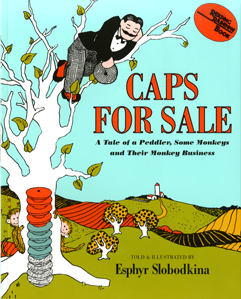
Today we celebrate National Hat Day. If you have ever met me, you know I am a hat fanatic. I began wearing them in the mid 1970s, when a bad haircut before a sales conference sent me into a tizzy. I stopped at a store on my way back to work and purchased a hat to hide my terrible hair. Before the haircut grew out, I realized that I loved wearing hats. What shoes did for Imelda Marcos—hats do for me. Given this propensity, I have always hunted for good books featuring my favorite apparel. Yet the one that still pleases me the most first appeared in 1940, Esphyr Slobodkina’s Caps for Sale.
Born in Siberia into a family of considerable artistic talent, Slobodkina fled Russia because of the Revolution, and in 1928 at the age of twenty, arrived in New York. She quickly becoming involved with a group of painters and sculptors called American Abstract Artists that included Josef Albers, Willem de Kooning, and Jackson Pollock. Much inspired by Henri Rousseau, she began showing her work with Arshile Gorky, Stuart Davis, and Mondrian.
But she needed to supplement her income and sought out Margaret Wise Brown, who at that point worked as an editor for William R. Scott, the independent, experimental publisher who would also release the work of Gertrude Stein for children. Dressed in a swirling Bohemian black cape and beaded skullcap, Slobodkina may have impressed Brown as much by her outfits as she did with the storyboards she delivered. Certainly Slobodkina’s fine sense of style was preserved in her nattily dressed peddler featured in Caps for Sale. Brown offered her work, and eventually the two created several books together, including The Little Fireman.
Finally, when Slobodkina got to write and illustrate her own book, she turned to a story passed on to her by her nephew, Caps for Sale: A Tale of a Peddler, Some Monkeys and Their Monkey Business. A peddler, with all of his wares stacked on his head, advertises his caps for sale. When he takes a nap, some monkeys steal the hats, put them on their heads, and climb into trees. When he asks for the hats back, the monkeys reply, “Tsz, tsz, tsz.” The repetitive refrain and the well-paced text make the book absolutely perfect for group sharing. For seventy-one years children have loved acting out the part of the mischievous animals in this spirited tale of monkeys and their monkey business.
I have never been able to resist the caps in the story. It makes me want to pile up my own hats and wear several at a time. Maybe I will do so for National Hat Day.
Here’s a page from Caps for Sale: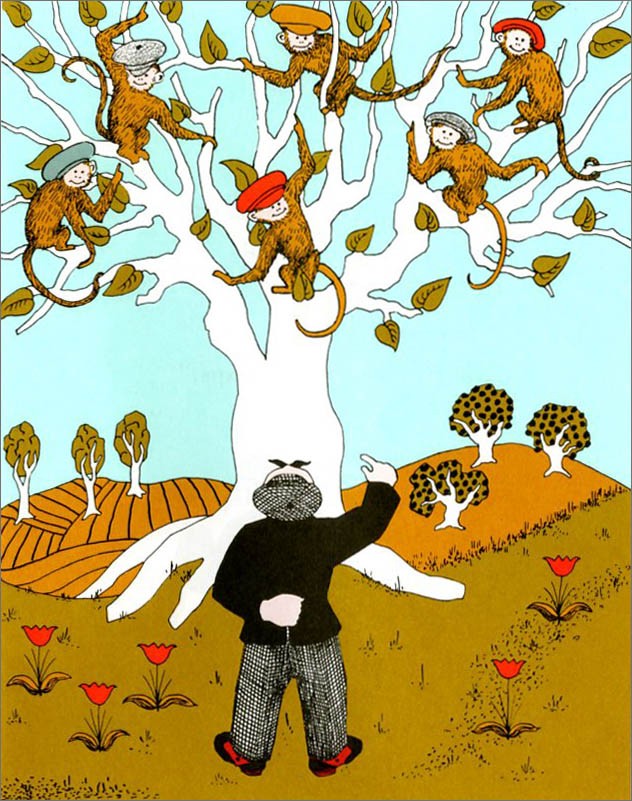
“You monkeys, you,”
he said,
shaking a finger at them,
“you give me back my caps.”
But the monkeys
only shook their fingers
back at him and said,
“Tsz, tsz, tsz.”