
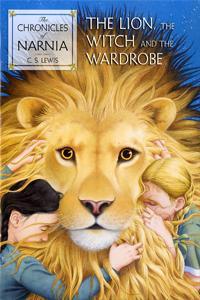
We are going to end the month with two birthday celebrations—one a writer, the other an illustrator. C. S. Lewis, today’s celebrant, was born on this day in 1898 in Belfast, Ireland. But he would live and write in Oxford, England, where he taught on the English faculty with his good friend and fellow author, J. R. R. Tolkien. C. S. Lewis also died in November, on the 22nd in 1963. Media coverage for him at that time was quite minimal due to the assassination that day of John Fitzgerald Kennedy and the death of English writer Aldous Huxley. But since 1963, Lewis has been written about, served as the subject of a movie, and read—by millions and millions of devoted fans. Although many of his adult books about Christianity like Surprised by Joy have remained popular, he is best remembered for his children’s fantasy series, The Chronicles of Narnia, which have sold more than a hundred million copies, been translated into forty-one languages, and established themselves as part of the cannon of children’s literature.
To write these books, Lewis mined images from his boyhood. When he was sixteen, he imagined a faun, carrying an umbrella in a snowy wood. Then around 1948 he began to weave a lion into this story, a book he called “The Lion.” Lewis became swept up in the tale that poured out of him. Although he originally intended it to be a single volume, in two years he wrote five books.
In The Lion, the Witch, and the Wardrobe, four children have been evacuated from London during the Blitz to stay with an elderly professor. By walking through a wardrobe, they find another kingdom, Narnia, under the spell of the evil White Witch. But the true king of Narnia, Aslan, has come to free this world—although to do so he will have to die and then rise again from the dead. In this series of seven books, Lewis wanted to see if he could find a way to describe Christianity so that it could be appreciated and understood by children.
But Lewis’s adult friends were not so amused. As part of a writer’s group called the Inklings, Lewis shared this work in progress with them. J. R. R. Tolkien, a member of the group, could not endure the Narnia tales. He considered them badly constructed and taking place in a less-than-cohesive alternate world. Although Tolkien was himself a genius at creating his own fantasy world, he missed the appeal of Lewis’s creation. The series is ideal for young fantasy readers, ages eight to twelve, who fall in love with the talking animals, fauns, and giants.
I myself have spent a lifetime looking at armoires, hoping that they have a false back door that leads to Narnia. Since I haven’t found one yet, I just pick up the books from time to time. Happy 113th birthday, C. S. Lewis. Our real world has been a better place because of the alternate universe that you created.
Here’s a passage from The Lion, the Witch and the Wardrobe:

This is the land of Narnia,” said the Faun, “where we are now; all that lies between the lamp-post and the great castle of Cair Paravel on the eastern sea. And you—you have come from the wild woods of the west?”
“I—I got in through the wardrobe in the spare room,” said Lucy.
“Ah!” said Mr. Tumnus in a rather melancholy voice, “if I only I had worked harder at geography when I was a little Faun, I should no doubt know all about those strange countries. It is too late now.”