
Daily children’s book recommendations and events from Anita Silvey.
Discover the stories behind the children’s book classics . . .
The new books on their way to becoming classics . . .
And events from the world of children’s books—and the world at large.

Find a Book!
Search the archives for recommendations by age group, book type, subject, date, and more.


On January 16, 1919, the ratification of the 18th Amendment to the Constitution was certified. The 18th Amendment forbids the manufacture and sale of alcohol in the United States. In many areas of the country, people felt justified breaking this particular law. I myself have Ohio ancestors who made and transported illegal liquor during this period. When I asked my great aunt about some of them who had been murdered, she responded simply, “Oh, they were moonshiners, honey. That is what happened in those days, you know.” I didn’t know. Fortunately a book published in 2006 will help children understand this period of United States history, even if it doesn’t happen to be their own personal family history.
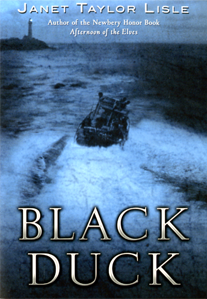
In Black Duck, Janet Taylor Lisle spins a fascinating tale for fifth through eighth graders that revolves around rum-running and Prohibition. Lisle sets the book along the Rhode Island coast, near Newport, a place of small beaches and landing spots. In the Narraganset Bay, small vessels made contact with alcohol-carrying boats from Canada, Europe, and the West Indies, moored outside of U.S. territorial limits. Then these boats brought the liquor to the coast, where it was unloaded in the middle of the night and often stored in cellars. Key to the story is the notorious Black Duck, a vessel that continually outruns the Coast Guard.
The protagonist of the story, David Peterson, has just finished eighth grade; he becomes intrigued by this part of Rhode Island’s past and sets out to record the story of Ruben Hart, now an old man, who as a boy had become involved with rum-running. Slowly Ruben opens up, about his own involvement and that of his best friend Jeddy. By the late 1920s everyone in the town—including the constables—were getting involved one way or another in this illicit trade. But so much money was being made that gangsters from first Boston and then New York begin to take over the territory. When Ruben and Jeddy find a dead man on the beach, and Ruben takes his pipe and tobacco pouch, they get swept into the alcohol trade. The boys change from innocence to becoming willing accomplices. In this time period, it is difficult to tell the good guys from the bad ones. Ruben gets kidnapped several times, and fortunately survives the last mission of the Black Duck, when three members of the crew are killed.
This mystery/adventure is so exciting, readers barely notice they are learning a good bit of local and national history, because the Rhode Island coastal community is such integral part of the story. If you want to explain the 18th Amendment or just entertain young readers, pick up Black Duck.
Here’s a passage from Black Duck:
Cornered against some dark beach, the Duck gunned her big engines and roared to freedom, leaving pursuers to wallow in her wake.
Also recommended:
- Moonshiner’s Son by Carolyn Reeder
Additional Information
A few other events for
- Happy birthday Robert Lipsyte (Center Field), Kate McMullan (I Stink!), and Andrew Glass (Mountain Men).
- The first edition of El Ingenioso Hidalgo Don Quijote de la Mancha (Book One of Don Quixote) by Miguel de Cervantes is published in Madrid, 1605.
- It’s Appreciate a Dragon Day. Identify your favorite dragon in children’s literature. Read My Father’s Dragon by Ruth Stiles Gannett.
- On National Nothing Day, don’t celebrate, observe or honor anything. Unless you want to. Read Nothing by Jon Agee and Tales of a Fourth Grade Nothing by Judy Blume.